
More vegetables, less meat and an alternative protein source: These menus provide variety in your furry friend's bowl.
More vegetables, less meat and an alternative protein source: These menus provide variety in your furry friend's bowl.
More vegetables, less meat and an alternative protein source: These menus provide variety in your furry friend's bowl.
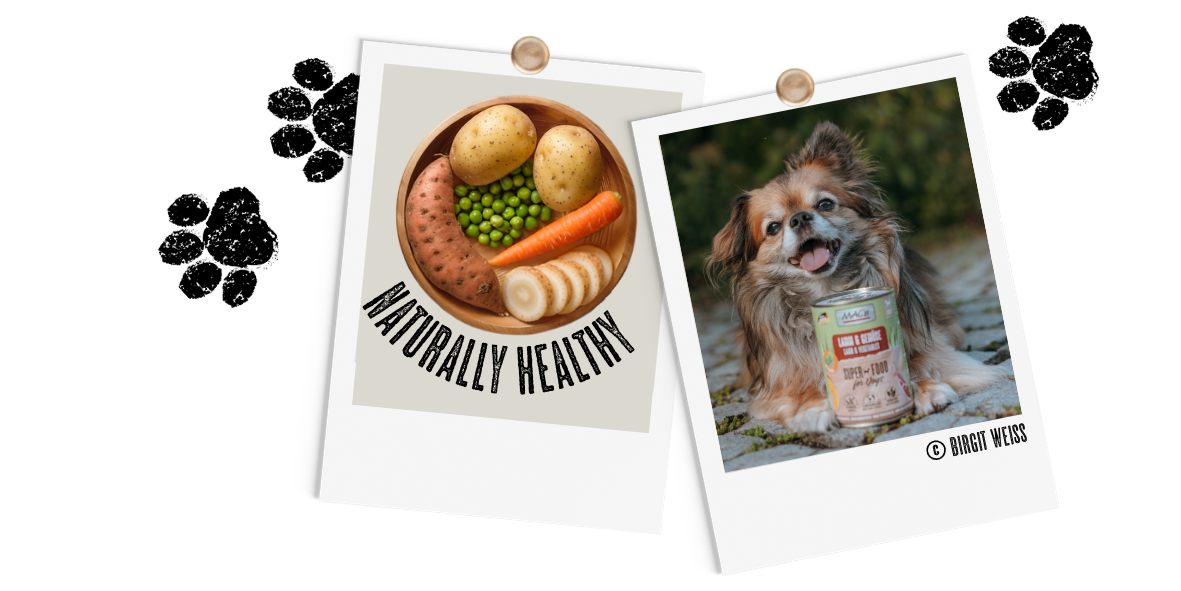
Our various varieties with a higher vegetable content or made from insects save more CO₂e than MAC's reference products with a high meat content, as they produce fewer greenhouse gases than animal-based foods. At the same time, they provide your dog with essential nutrients and minerals needed for a healthy life. Specific comparisons ofraw material-based CO₂e emissions with reference products can be found with the respective vegetable and insect products.
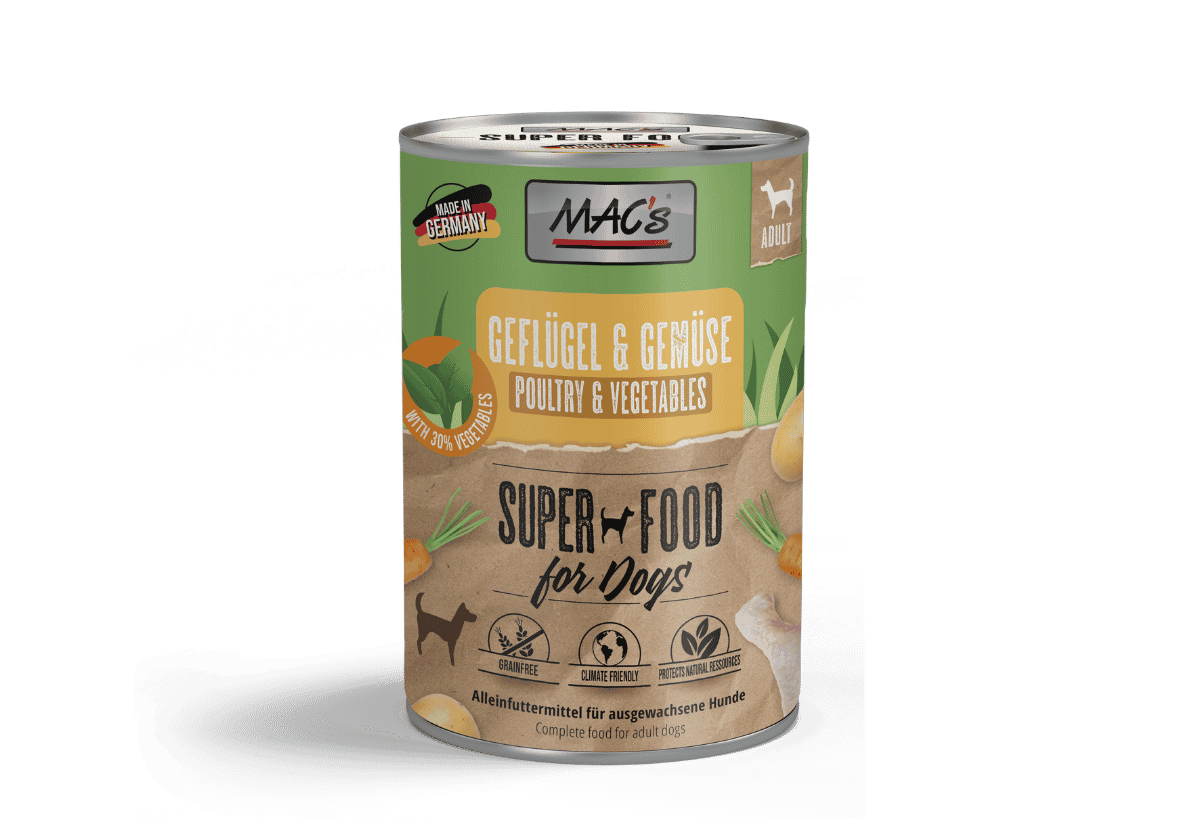
400 g & 800 g
40% chicken (consisting of chicken gizzards, chicken meat, chicken hearts, chicken livers, chicken broth), 29% turkey (consisting of turkey meat, turkey broth), 15% carrots, 15% potatoes, 1% minerals
Crude protein 7.5%,
crude fat 3.5%,
crude fiber 0.4%,
crude ash 2.0%,
moisture 82.0%
Vitamin D3 200 IU
zinc (zinc sulfate, Monohydrate) 25 mg
manganese (manganese (II) sulfate, Monohydrate) 1.4 mg
iodine (calcium iodate, anhydrous) 0.75 mg
2.5kg – 314-325g
5kg – 527-548g
10kg – 886-921g
15kg – 1201-1249g
20kg – 1490-1549g
25kg – 1762-1831g
30kg – 2019-2100g
35kg – 2267-2358g
40kg – 2506-2607g
45kg – 2738-2847g
50kg – 2962-3080g
60kg – 3397-3533g
70kg – 3813-3965g
2.5kg – 238-276g
5kg – 401-464g
10kg – 673-780g
15kg – 913-1056g
20kg – 1132-1311g
25kg – 1339-1550g
30kg – 1535-1777g
35kg – 1723-1995g
40kg – 1904-2206g
45kg – 2081-2409g
50kg – 2251-2607g
60kg – 2581-2988g
70kg – 2898-3355g
2.5kg – 200-238g
5kg – 337-401g
10kg – 567-673g
15kg – 769-913g
20kg – 954-1132g
25kg – 1127-1339g
30kg – 1292-1535g
35kg – 1451-1723g
40kg – 1603-1904g
45kg – 1752-2081g
50kg – 1896-2251g
60kg – 2174-2581g
70kg – 2440-2898g
These figures are guidelines only. Your pet's actual nutritional needs vary and may differ depending on age, sex, breed, or activity level.
This variety has raw material-based CO₂e emissions of 3.66 kg CO₂e per 800g can. The comparable product, MAC's MonoProtein Fresh Turkey, has 4.83 kg CO₂e per 800g can. This results in a saving of 24% in a direct comparison.
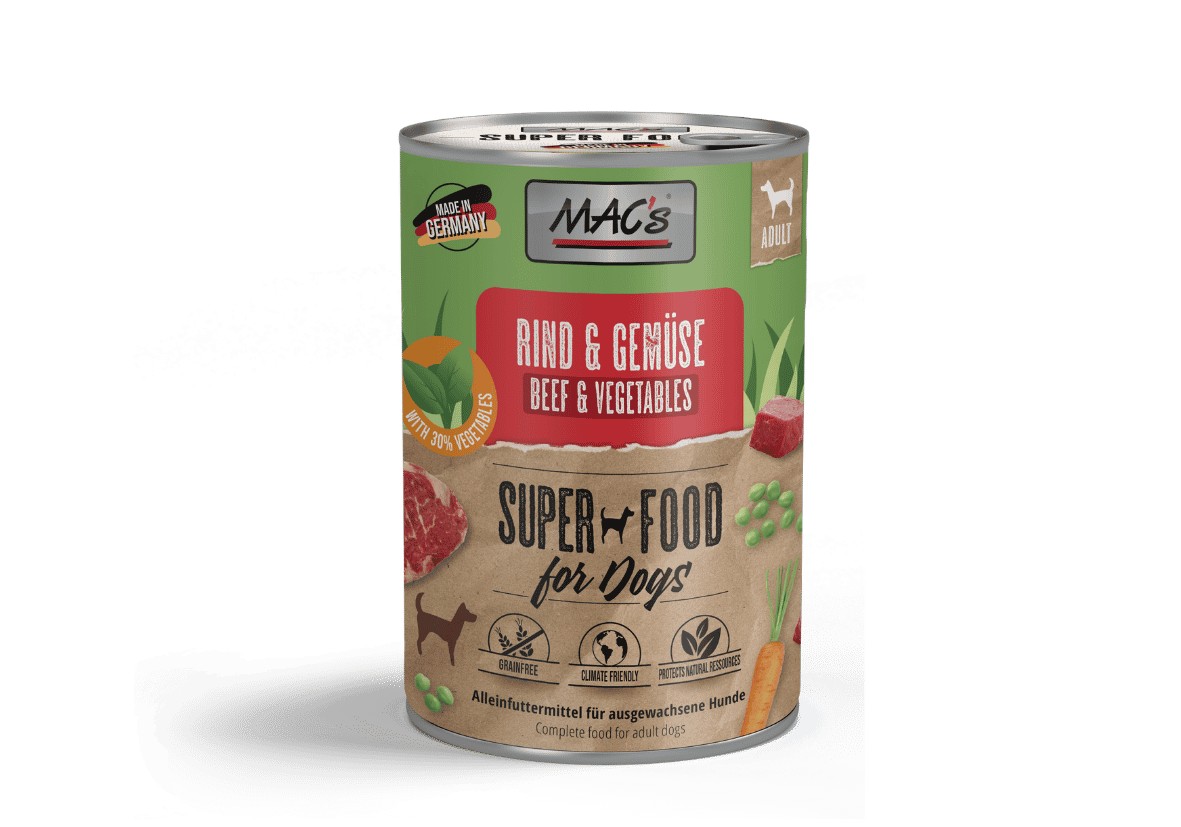
400 g & 800 g
69% beef (consisting of beef, beef heart, beef lung, beef liver, beef broth), 20% carrot, 10% pea, 1% minerals.
Crude protein 8.2%,
crude fat 4.0%,
crude fiber 0.5%,
crude ash 2.0%,
moisture 82.0%
Vitamin D3 200 IU
zinc (zinc sulfate, Monohydrate) 25 mg
manganese (manganese (II) sulfate, Monohydrate) 1.4 mg
iodine (calcium iodate, anhydrous) 0.75 mg
2.5kg – 304-315g
5kg – 510-531g
10kg – 859-893g
15kg – 1164-1210g
20kg – 1443-1501g
25kg – 1707-1774g
30kg – 1956-2035g
35kg – 2197-2285g
40kg – 2428-2526g
45kg – 2653-2759g
50kg – 2870-2985g
60kg – 3291-3423g
70kg – 3694-3842g
2.5kg – 231-267g
5kg – 388-449g
10kg – 652-756g
15kg – 884-1023g
20kg – 1097-1270g
25kg – 1297-1502g
30kg – 1487-1722g
35kg – 1669-1933g
40kg - 1845-2137g
45kg - 2016-2334g
50kg - 2181-2526g
60kg - 2501-2896g
70kg - 2808-3251g
2.5kg – 194-231g
5kg – 326-388g
10kg – 550-652g
15kg – 745-884g
20kg – 924-1097g
25kg – 1092-1297g
30kg – 1252-1487g
35kg – 1406-1669g
40kg – 1553-1845g
45kg – 1698-2016g
50kg – 1903-2181g
60kg – 2107-2501g
70kg – 2364-2808g
These figures are guidelines only. Your pet's actual nutritional needs vary and may differ depending on age, sex, breed, or activity level.
This variety has raw material-based CO₂e emissions of 14.19 kg CO₂e per 800g can. The comparable product, MAC's Beef & Pumpkin, has 19.06 kg CO₂e per 800g can. This results in a saving of 25% in a direct comparison.
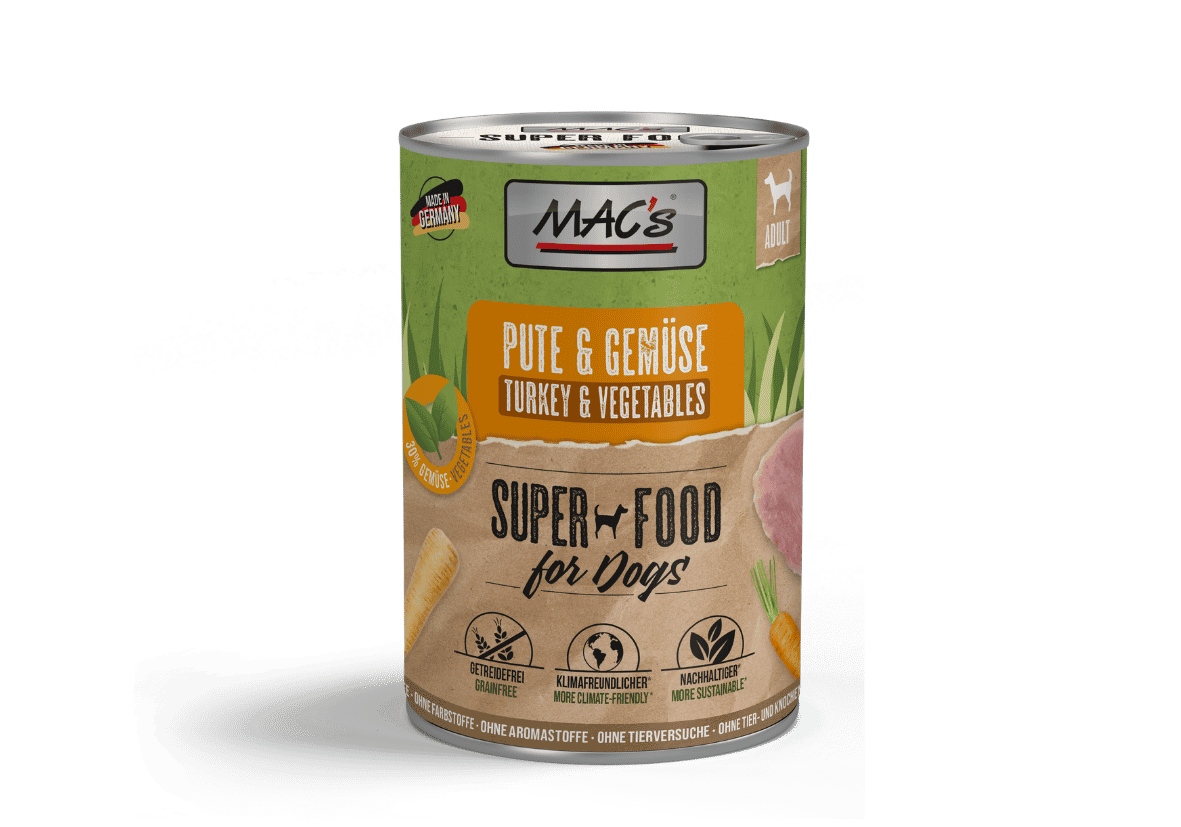
400 g & 800 g
69% turkey (consisting of turkey meat, turkey gizzard, turkey heart, turkey liver, turkey broth), 15% parsnip, 15% carrot, 1% minerals.
Crude protein 6.9%,
crude fat 3.8%,
crude ash 1.7%
, crude fiber 0.5%,
moisture 83.0%
Vitamin D3 200 IU
zinc (zinc sulfate, Monohydrate) 25 mg
manganese (manganese (II) sulfate, Monohydrate) 1.4 mg
iodine (calcium iodate, anhydrous) 0.75 mg
copper (copper (II) sulfate, pentahydrate) 1.0 mg
2.5kg – 334-346g
5kg – 561-584g
10kg – 943-981g
15kg – 1279-1330g
20kg – 1586-1649g
25kg – 1876-1950g
30kg – 2150g-2236g
35kg – 2414-2511g
40kg – 2668-2775g
45kg – 2915-3031g
50kg – 3154-3280g
60kg – 3616-3761g
70kg – 4059-4222g
2.5kg – 254-294g
5kg – 427-494g
10kg – 717-831g
15kg – 972-1125
20kg – 1205-1396g
25kg – 1425-1651g
30kg – 1634-1892g
35kg – 1834-2124g
40kg – 2028-2348g
45kg – 2216-2564g
50kg – 2397-2775g
60kg – 2748-3182g
70kg – 3085-2572g
2.5kg – 213-254g
5kg – 358-427g
10kg – 604-717g
15kg – 819-972g
20kg – 1016-1205g
25kg – 1200-1425g
30kg – 1375-1634g
35kg – 1545-1834g
40kg – 1707-2028g
45kg – 1865-2216g
50kg – 2091-2397g
60kg – 2315-2748g
70kg – 2598-3085g
These figures are guidelines only. Your pet's actual nutritional needs vary and may differ depending on age, sex, breed, or activity level.
This variety has raw material-based CO₂e emissions of 3.7 kg CO₂e per 800g can. The comparable product, MAC's MonoProtein Fresh Turkey, has 4.83 kg CO₂e per 800g can. This results in a saving of 23% in a direct comparison.
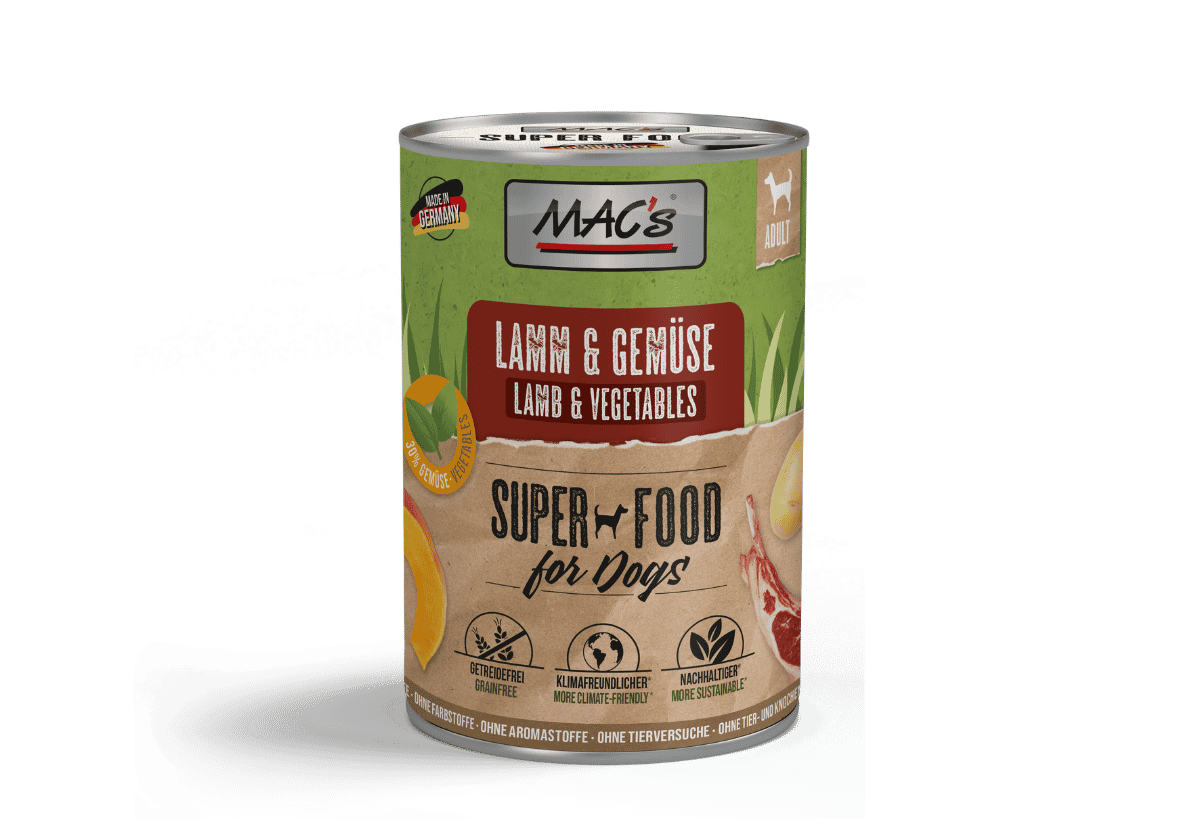
400 g & 800 g
69% Lamb (consisting of lamb meat, lamb lung, lamb liver, lamb heart, lamb broth), 15% Pumpkin, 15% Potato, 1% Minerals
Crude protein 7.0%
Crude fat 5.1%
Crude fiber 0.6%
Crude ash 1.7
% Moisture 83.0%
Vitamin D3 200 IU
zinc (zinc sulfate, Monohydrate) 25 mg
manganese (manganese (II) sulfate, Monohydrate) 1.4 mg
iodine (calcium iodate, anhydrous) 0.75 mg
copper (copper (II) sulfate, pentahydrate) 1.0 mg
2.5kg: 312-324g
5kg: 524-546g
10kg: 882-917g
15kg: 1196-1234g
20kg: 1483-1542g
25kg: 1754-1823g
30kg: 2010-2090g
35kg: 2257-2348g
40kg: 2494-2595g
45kg: 2725-2834g
50kg: 2949-3066g
60kg: 3381-3517g
70kg: 3795-3947g
2.5kg: 237-275g
5kg: 399-462g
10kg: 670-777g
15kg: 908-1051g
20kg: 1127-1305g
25kg: 1332-1543g
30kg: 1528-1769g
35kg: 1715-1986g
40kg: 1896-2196g
45kg: 2072-2398g
50kg: 2241-2595g
65kg: 2570-2975g
70kg: 2885-3340g
2.5kg: 199-237g
5kg: 335-399g
10kg: 565-670g
15kg: 765-908g
20kg: 950-1127g
25kg: 1122-1332g
30kg: 1286-1528g
35kg: 1444-1715g
40kg: 1596-1896g
45kg: 1744-2072g
50kg: 1955-2241g
60kg: 2164-2570g
70kg: 2429-2885g
These figures are guidelines only. Your pet's actual nutritional needs vary and may differ depending on age, sex, breed, or activity level.
This variety has raw material-based CO₂e emissions of 19.74 kg CO₂e per 800g can. The comparable product, MAC's MonoProtein Fresh Lamb, has 26.56 kg CO₂e per 800g can. This results in a saving of 25% in a direct comparison.
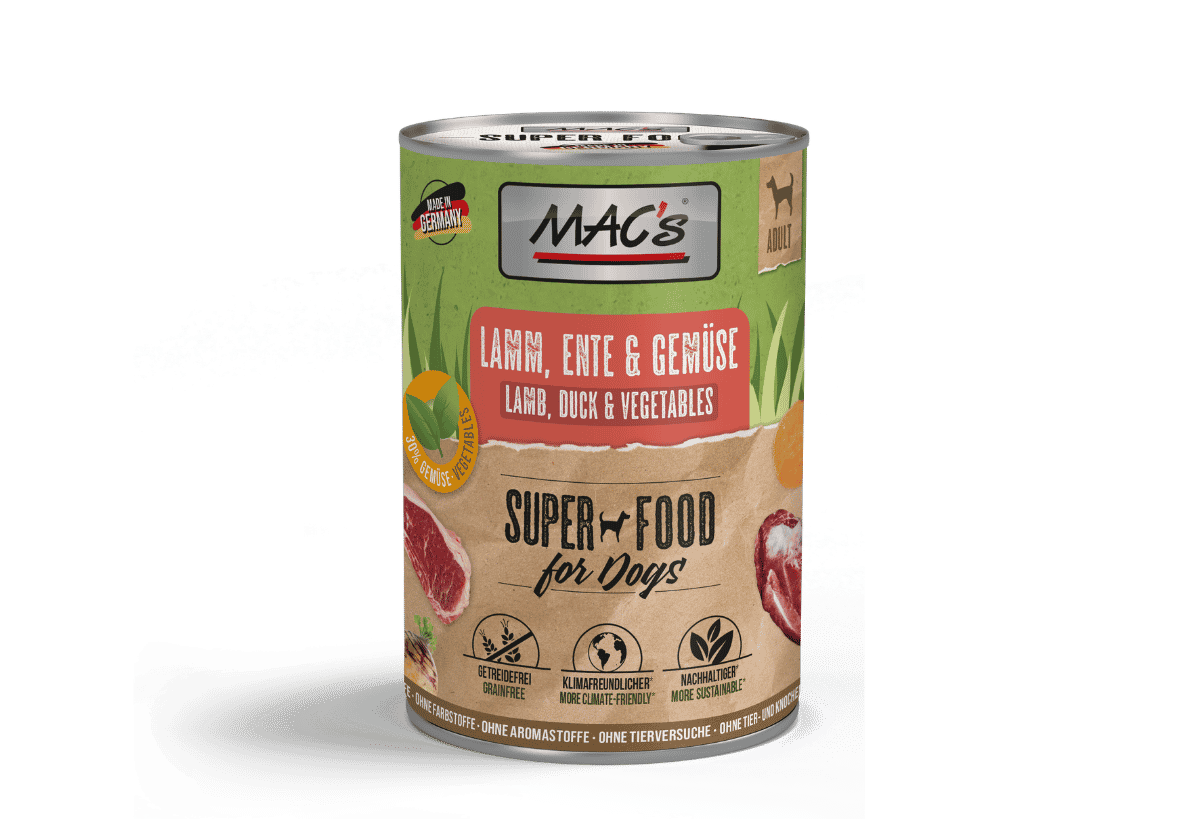
400 g & 800 g
39% Lamb (consisting of lamb meat, lamb lungs, lamb liver, lamb tripe, lamb broth), 30% Duck (consisting of duck meat, duck broth), 15% Sweet potato, 10% Swede, 5% Jerusalem artichoke, 1% Minerals
Crude protein 7.1%
Crude fat 5.1%
Crude fiber 0.4%
Crude ash 2.2
% Moisture 82.0%
Vitamin D3 200 IU
zinc (zinc sulfate, Monohydrate) 25 mg
manganese (manganese (II) sulfate, Monohydrate) 1.4 mg
iodine (calcium iodate, anhydrous) 0.75 mg
copper (copper (II) sulfate, pentahydrate) 1.0 mg
2.5kg - 298 - 309g
5kg - 501 - 521g
10kg - 843 - 876g
15kg - 1142 - 1188g
20kg - 1417 - 1473g
25kg - 1676 - 1742g
30kg - 1920 - 1997g
35kg – 2156 – 2243g
40kg – 2383 – 2479g
45kg – 2603 – 2708g
50kg – 2817 – 2929g
60kg – 3230 – 3360g
70kg – 3626 – 3771g
2.5kg – 227 – 263g
5kg – 381 – 441g
10kg – 640 – 742g
15kg – 868 – 1004g
20kg – 1076 – 1247g
25kg – 1273 – 1474g
30kg – 1460 – 1690g
35kg – 1639 - 1897g
40kg - 1811 - 2098g
45kg - 1979 - 2291g
50kg - 2141 - 2479g
60kg - 2455 - 2842g
70kg - 2756 - 3191g
2.5kg – 191 – 227g
5kg – 320 – 381g
10kg – 539 – 640g
15kg – 731 – 868g
20kg – 907 – 1076g
25kg – 1072 – 1273g
30kg – 1229 – 1460g
35kg – 1380 - 1639g
40kg - 1525 - 1811g
45kg - 1666 - 1979g
50kg - 1867 - 2141g
60kg - 2068 - 2455g
70kg - 2321 - 2756g
These figures are guidelines only. Your pet's actual nutritional needs vary and may differ depending on age, sex, breed, or activity level.
This variety has raw material-based CO₂e emissions of 13.25 kg CO₂e per 800g can. The comparable product, MAC's Lamb & Duck, has 23.34 kg CO₂e per 800g can. This results in a saving of at least 30% in a direct comparison.
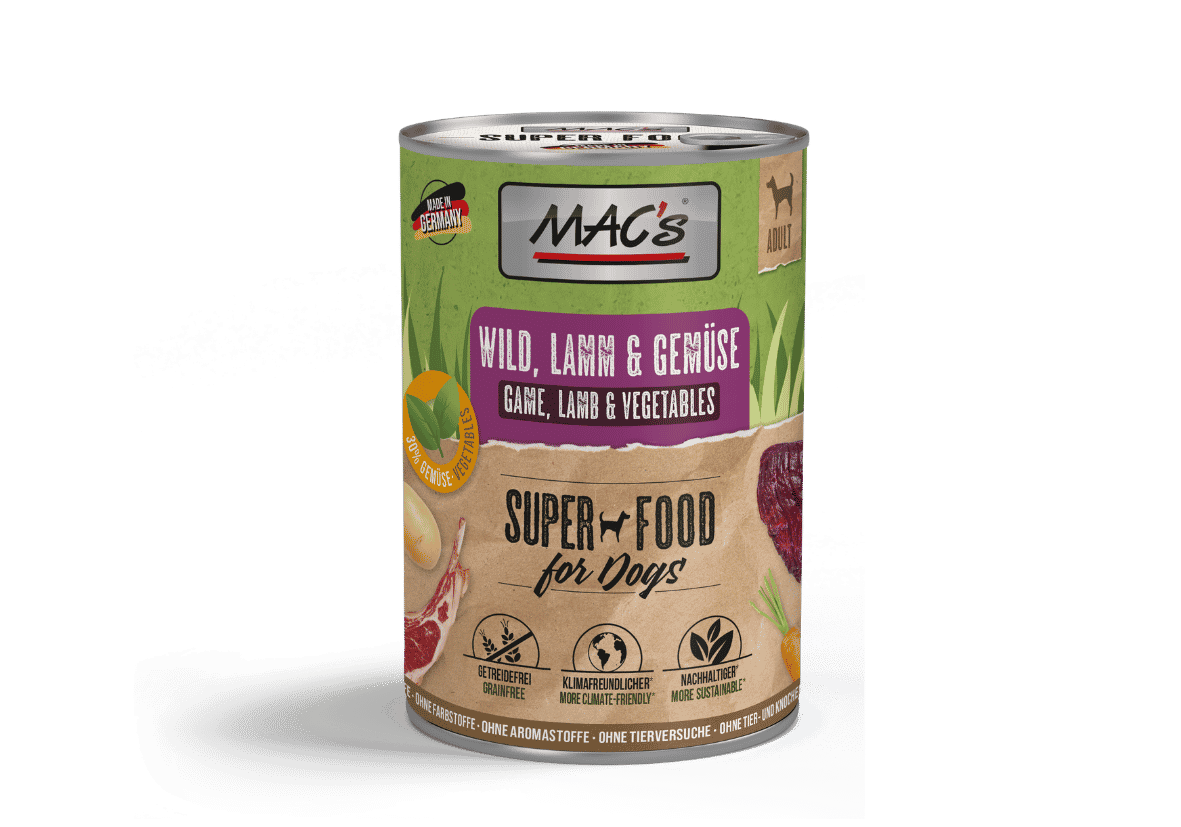
400 g & 800 g
37.2% Lamb (consisting of lamb meat, lamb lungs, lamb liver, lamb tripe, lamb broth), 31.8% Venison (consisting of venison, venison broth), 15% Carrot, 15% Potato, 1% Minerals
Crude protein 6.9%,
crude fat 4.8%,
crude fiber 0.5%,
crude ash 2.1%,
moisture 82.0%
Vitamin D3 200 IU
zinc (zinc sulfate, Monohydrate) 25 mg
manganese (manganese (II) sulfate, Monohydrate) 1.4 mg
iodine (calcium iodate, anhydrous) 0.75 mg
copper (copper (II) sulfate, pentahydrate) 1.0 mg
2.5kg - 305 - 317g
5kg - 513 - 534g
10kg - 862 - 897g
15kg - 1169 - 1216g
20kg - 1450 - 1508g
25kg - 1715 - 1783g
30kg - 1965 - 2044g
35kg – 2207 – 2295g
40kg – 2439 – 2537g
45kg – 2665 – 2771g
50kg – 2883 – 2998g
60kg – 3306 – 3439g
70kg – 3711 – 3860g
2.5kg – 232 – 269g
5kg – 390 – 451g
10kg – 655 – 759g
15kg – 888 – 1028g
20kg – 1102 – 1276g
25kg – 1303 – 1509g
30kg – 1494 – 1730g
35kg – 1677 - 1942g
40kg - 1854 - 2147g
45kg - 2026 - 2345g
50kg - 2191 - 2537g
60kg - 2513 - 2909g
70kg - 2821 - 3266g
2.5kg – 195 – 232g
5kg – 328 – 390g
10kg – 552 – 655g
15kg – 748 – 888g
20kg – 929 – 1102g
25kg – 1097 – 1303g
30kg – 1258 – 1494g
35kg – 1412 - 1677g
40kg - 1561 - 1854g
45kg - 1705 - 2026g
50kg - 1911 - 2191g
60kg - 2116 - 2513g
70kg - 2375 - 2821g
These figures are guidelines only. Your pet's actual nutritional needs vary and may differ depending on age, sex, breed, or activity level.
This variety has raw material-based CO₂e emissions of 15.34 kg CO₂e per 800g can. The comparable product, MAC's Wild & Lamb, has 24.33 kg CO₂e per 800g can. This results in a saving of at least 30% in a direct comparison.
Your four-legged friend's ecological footprint (or paw print) could be bigger than you think. In a study, scientists calculated the average CO₂ consumption of a 15-kilogram dog with a life expectancy of 13 years. They found that a dog produces roughly the same amount of greenhouse gases over its lifetime as 13 round-trip flights from Berlin to Barcelona.¹ That's quite a lot! The biggest factor is food.
If you want to reduce the raw material-based CO₂e emissions associated with your dog's food , our menus with more vegetables are a great option. The higher vegetable content of these varieties means fewer greenhouse gases from animal products: According to the German Federal Environment Agency, for example, the CO₂ footprint of potatoes is 0.2 kg CO₂e per kilogram, while that of beef averages 13.6 kg CO₂e.² Comparing our menus with more vegetables to a conventional meat product also illustrates this difference: The 800g can of our Poultry & Vegetable variety has a CO₂e of 3.66 kg, while our comparable MonoProtein Fresh Turkey variety, with over 93 percent turkey, has a CO₂e of 4.83 kg per 800g can.³
Secondary plant compounds are not essential for the survival of plants themselves, but they have beneficial properties for our four-legged friends. These are pigments, fragrances, and flavor compounds that occur naturally in plants. One example is beta-carotene, which occurs naturally in carrots and can support cell growth and the immune system.
Want to learn more about the positive properties of our ingredients?
Here's a list of our ingredients and their effects.

Our varieties with more vegetables are made from high-quality raw materials, almost exclusively from German producers. The high vegetable content can promote fast, gentle digestion and strengthen the immune system with additional vitamins. Based on the natural needs of dogs, the different varieties ensure a healthy and balanced diet.
With fresh meat and a 30 percent vegetable content, these varieties provide essential vitamins and fiber that your four-legged friend needs for a long, healthy life. The grain-free recipes are based on a dog's natural diet and contain only functional ingredients from nature.
Your four-legged friend's ecological footprint (or paw print) could be bigger than you think. In a study, scientists calculated the average CO₂ consumption of a 15-kilogram dog with a life expectancy of 13 years. They found that a dog produces roughly the same amount of greenhouse gases over its lifetime as 13 round-trip flights from Berlin to Barcelona.¹ That's quite a lot! The biggest factor is food.
If you want to reduce the raw material-based CO₂e emissions associated with your dog's food , our menus with more vegetables are a great option. The higher vegetable content of these varieties means fewer greenhouse gases from animal products: According to the German Federal Environment Agency, for example, the CO₂ footprint of potatoes is 0.2 kg CO₂e per kilogram, while that of beef averages 13.6 kg CO₂e.² Comparing our menus with more vegetables to a conventional meat product also illustrates this difference: The 800g can of our Poultry & Vegetable variety has a CO₂e of 3.66 kg, while our comparable MonoProtein Fresh Turkey variety, with over 93 percent turkey, has a CO₂e of 4.83 kg per 800g can.³
Secondary plant compounds are not essential for the survival of plants themselves, but they have beneficial properties for our four-legged friends. These are pigments, fragrances, and flavor compounds that occur naturally in plants. One example is beta-carotene, which occurs naturally in carrots and can support cell growth and the immune system.

Our varieties with more vegetables are made from high-quality raw materials, almost exclusively from German producers. The high vegetable content can promote fast, gentle digestion and strengthen the immune system with additional vitamins. Based on the natural needs of dogs, the different varieties ensure a healthy and balanced diet.
With fresh meat and a 30 percent vegetable content, these varieties provide essential vitamins and fiber that your four-legged friend needs for a long, healthy life. The grain-free recipes are based on a dog's natural diet and contain only functional ingredients from nature.
Your four-legged friend's ecological footprint (or paw print) could be bigger than you think. In a study, scientists calculated the average CO₂ consumption of a 15-kilogram dog with a life expectancy of 13 years. They found that a dog produces roughly the same amount of greenhouse gases over its lifetime as 13 round-trip flights from Berlin to Barcelona.¹ That's quite a lot! The biggest factor is food.
If you want to reduce the raw material-based CO₂e emissions associated with your dog's food , our menus with more vegetables are a great option. The higher vegetable content of these varieties means fewer greenhouse gases from animal products: According to the German Federal Environment Agency, for example, the CO₂ footprint of potatoes is 0.2 kg CO₂e per kilogram, while that of beef averages 13.6 kg CO₂e.² Comparing our menus with more vegetables to a conventional meat product also illustrates this difference: The 800g can of our Poultry & Vegetable variety has a CO₂e of 3.66 kg, while our comparable MonoProtein Fresh Turkey variety, with over 93 percent turkey, has a CO₂e of 4.83 kg per 800g can.³
Secondary plant compounds are not essential for the survival of plants themselves, but they have beneficial properties for our four-legged friends. These are pigments, fragrances, and flavor compounds that occur naturally in plants. One example is beta-carotene, which occurs naturally in carrots and can support cell growth and the immune system.
Want to learn more about the positive properties of our ingredients? Here's a list of our ingredients and their effects.
Our varieties with more vegetables are made from high-quality raw materials, almost exclusively from German producers. The high vegetable content can promote fast, gentle digestion and strengthen the immune system with additional vitamins. Based on the natural needs of dogs, the different varieties ensure a healthy and balanced diet.
With fresh meat and a 30 percent vegetable content, these varieties provide essential vitamins and fiber that your four-legged friend needs for a long, healthy life. The grain-free recipes are based on a dog's natural diet and contain only functional ingredients from nature.

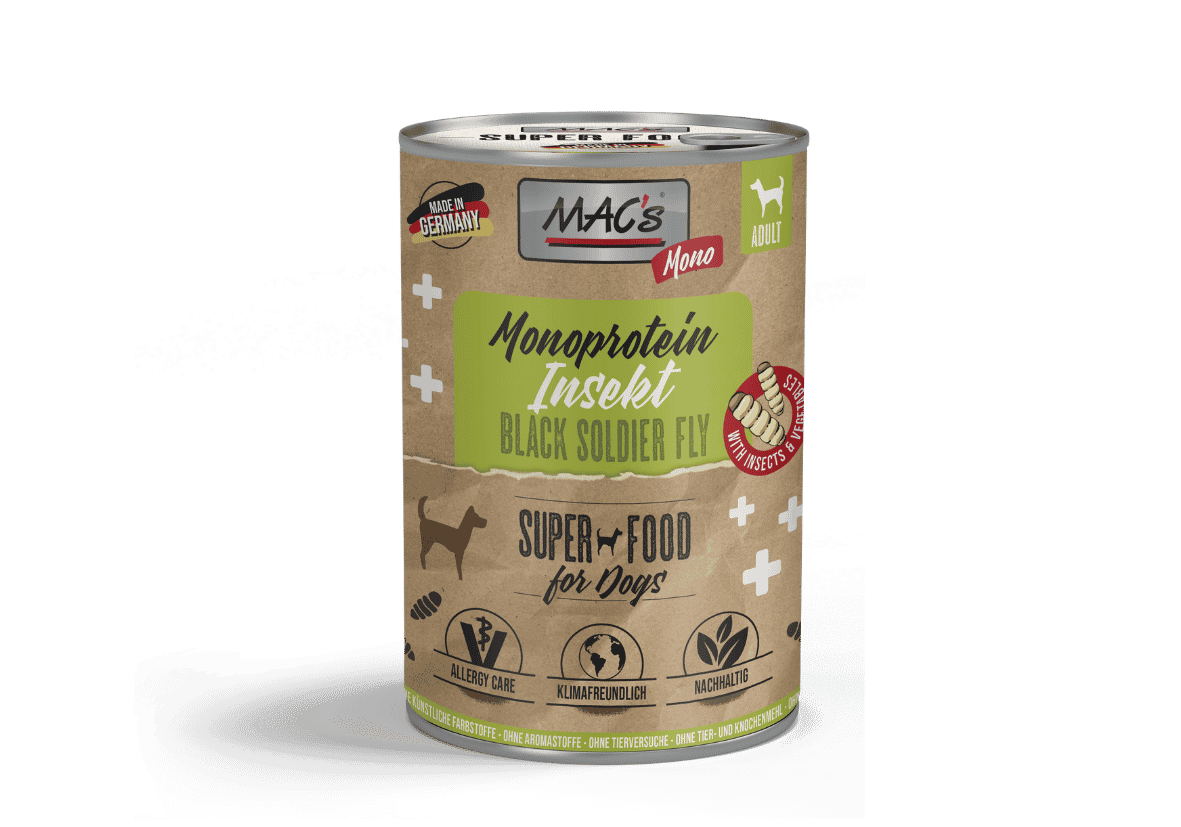
180 g, 375 g & 750 g
35% insects (black soldier fly), 29% broth, 15% carrot, 10% pumpkin, 10% sweet potato, 1% minerals.
Crude protein 7.0%
Crude fat 4.5%
Crude ash 2.0%
Crude fiber 1.0%
Moisture 80.0%
Vitamin A 2,000 i. E.
Vitamin D3 200 IU
zinc (zinc sulfate, Monohydrate) 25 mg
iodine (calcium iodate, anhydrous) 0.75 mg
selenium (sodium selenite) 0.05 mg
copper (copper (II) sulfate, pentahydrate 1.0 mg
2.5kg – 275-285g
5kg – 462-481g
10kg – 777-808g
15kg – 1054-1096g
20kg – 1307-1359g
25kg – 1546-1607g
30kg – 1771-1842g
35kg – 1989-2069g
40kg - 2198-2287g
45kg - 2402-2498g
50kg - 2599-2703g
60kg - 2980-3099g
70kg - 3345-3479g
2.5kg – 209-242g
5kg – 352-407g
10kg – 590-684g
15kg – 801-927g
20kg – 993-1150g
25kg – 1174-1360g
30kg – 1347-1559g
35kg – 1512-1750g
40kg – 1671-1935g
45kg – 1826-2113g
50kg – 1975-2287g
60kg – 2265-2622g
70kg – 2542-2944g
2.5kg - 176-209g
5kg - 295-352g
10kg - 498-590g
15kg - 675-801g
20kg - 837-993g
25kg - 989-1174g
30kg - 1133-1347g
35kg - 1273-1512g
40kg - 1407-1671g
45kg - 1537-1826g
50kg - 1723-1975g
60kg - 1907-2265g
70kg - 2141-2542g
These figures are guidelines only. Your pet's actual nutritional needs vary and may differ depending on age, sex, breed, or activity level.
Using insects instead of meat saves at least 80% of raw material-based CO₂e emissions for the protein raw material.
For our raw material comparison, we deliberately chose the lowest meat emission factor from our calculation basis as a reference. This is 6.00 kg CO₂e per kg of raw material for chicken.
The emission factor used for the insect raw material is 0.631 kg CO₂e per kg raw material.
Based on these emission factors, the calculated value for the insect raw material is approximately 89.5% lower. The values used are based on external life cycle assessment and database data and are used as approximations for comparing raw materials.
Source of insect raw material:
MUTATEC / i-Care – preliminary life cycle assessment for moist insect ingredients from black soldier fly larvae, 0.631 kg CO₂e/kg.
Source: Chicken:
AGRIBALYSIS – 6.00 kg CO₂e/kg.

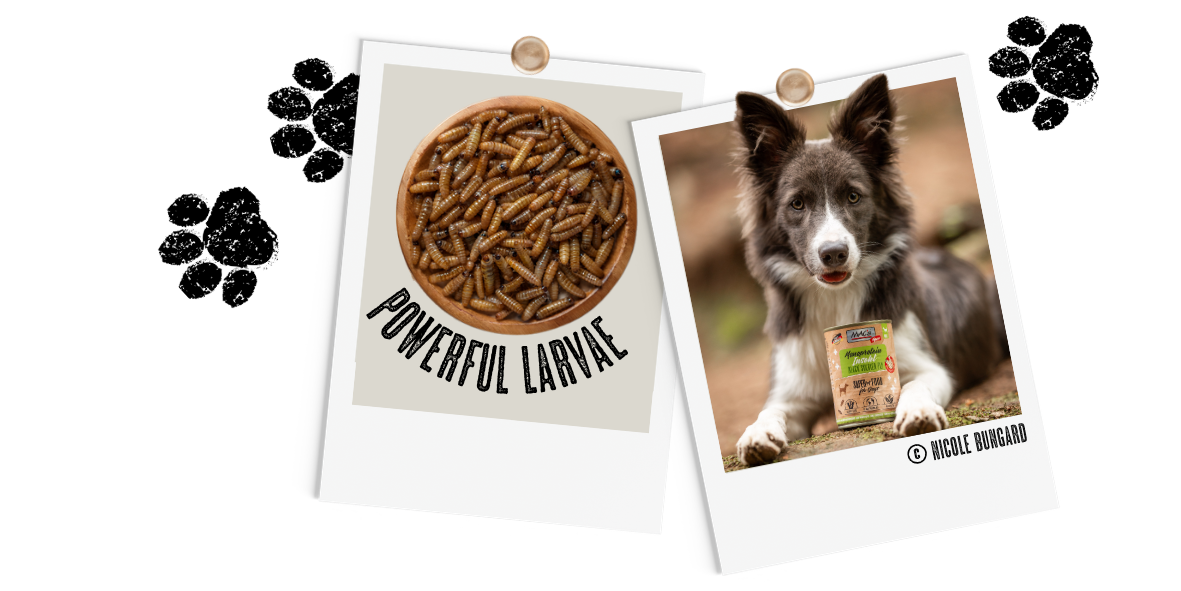
Black soldier flies, also known as Hermetia illucens , are truly remarkable flies. Originally from the subtropical regions of the Americas, they cannot survive in Germany due to our temperate climate. Their life cycle is approximately six weeks, making their breeding more time-efficient compared to cattle or pigs .
Their larvae grow rapidly: within a few weeks they gorge themselves, accumulating large amounts of protein and fat.⁴ They have the ability to convert any organic waste into valuable protein and can thus recycle food scraps.⁵
At the same time, the black soldier fly requires significantly less space compared to conventional protein sources . The larvae grow in a small area and do not require large pastures or cultivated land.⁶ Furthermore, their carbon footprint is considerably lower: A study published in 2024 on a black soldier fly farm determined that the carbon footprint for producing fresh larvae was approximately 30 times lower than that of conventional animal farming.⁷
Black soldier flies are an innovative protein sourcethat your dog has most likely never encountered before. This makes them particularly suitable for dogs sensitive to certain protein sources. A dog's immune system typically reacts best to ingredients it has previously been exposed to. Therefore, a pre-existing sensitivity is less likely with a previously unknown protein source.
Want to learn more about allergies and intolerances in dogs? We've compiled the most important information for you on our blog.
Click here to read the article.

As animal feed, the larvae are the perfect alternative: they are packed with important minerals, proteins, and high-quality fatty acids. Besides zinc and iron, they also provide calcium and vitamin B1.
A 2019 study by the Institute of Animal Nutrition at the University of Veterinary Medicine Hannover investigated how well dog food made from black soldier fly larvae is tolerated and digested. The study found that the food is digested just as well as a chicken-based variety.⁸ Also of interest: the insect-based food resulted in well-formed, firmer stools and thus better stool quality than the chicken-based food.⁹
Black soldier flies are an innovative protein sourcethat your dog has most likely never encountered before. This makes them particularly suitable for dogs sensitive to certain protein sources. A dog's immune system typically reacts best to ingredients it has previously been exposed to. Therefore, a pre-existing sensitivity is less likely with a previously unknown protein source.
Want to learn more about allergies and intolerances in dogs? We've compiled the most important information for you on our blog. Click here to read the article.
As animal feed, the larvae are the perfect alternative: they are packed with important minerals, proteins, and high-quality fatty acids. Besides zinc and iron, they also provide calcium and vitamin B1.
A 2019 study by the Institute of Animal Nutrition at the University of Veterinary Medicine Hannover investigated how well dog food made from black soldier fly larvae is tolerated and digested. The study found that the food is digested just as well as a chicken-based variety.⁸ Also of interest: the insect-based food resulted in well-formed, firmer stools and thus better stool quality than the chicken-based food.⁹
Black soldier flies, also known as Hermetia illucens , are truly remarkable flies. Originally from the subtropical regions of the Americas, they cannot survive in Germany due to our temperate climate. Their life cycle is approximately six weeks, making their breeding more time-efficient compared to cattle or pigs .
Their larvae grow rapidly: within a few weeks they gorge themselves, accumulating large amounts of protein and fat.⁴ They have the ability to convert any organic waste into valuable protein and can thus recycle food scraps.⁵
At the same time, the black soldier fly requires significantly less space compared to conventional protein sources . The larvae grow in a small area and do not require large pastures or cultivated land.⁶ Furthermore, their carbon footprint is considerably lower: A study published in 2024 on a black soldier fly farm found that the carbon footprint for producing fresh larvae was approximately 30 times lower than that of conventional animal farming.⁷
Black soldier flies are an innovative protein sourcethat your dog has most likely never encountered before. This makes them particularly suitable for dogs sensitive to certain protein sources. A dog's immune system typically reacts best to ingredients it has previously been exposed to. Therefore, a pre-existing sensitivity is less likely with a previously unknown protein source.

As animal feed, the larvae are the perfect alternative: they are packed with important minerals, proteins, and high-quality fatty acids. Besides zinc and iron, they also provide calcium and vitamin B1.
A 2019 study by the Institute of Animal Nutrition at the University of Veterinary Medicine Hannover investigated how well dog food made from black soldier fly larvae is tolerated and digested. The study found that the food is digested just as well as a chicken-based variety.⁸ Also of interest: the insect-based food resulted in well-formed, firmer stools and thus better stool quality than the chicken-based food.⁹
Black soldier flies, also known as Hermetia illucens , are truly remarkable flies. Originally from the subtropical regions of the Americas, they cannot survive in Germany due to our temperate climate. Their life cycle is approximately six weeks, making their breeding more time-efficient compared to cattle or pigs .
Their larvae grow rapidly: within a few weeks they gorge themselves, accumulating large amounts of protein and fat.⁴ They have the ability to convert any organic waste into valuable protein and can thus recycle food scraps.⁵
At the same time, the black soldier fly requires significantly less space compared to conventional protein sources . The larvae grow in a small area and do not require large pastures or cultivated land.⁶ Furthermore, their ecological footprint is considerably lower: A study published in 2024 on a black soldier fly farm determined that the CO2 footprint for the production of fresh larvae was approximately 30 times lower than that of conventional animal farming.⁷
Black soldier flies are an innovative protein sourcethat your dog has most likely never encountered before. This makes them particularly suitable for dogs sensitive to certain protein sources. A dog's immune system typically reacts best to ingredients it has previously been exposed to. Therefore, a pre-existing sensitivity is less likely with a previously unknown protein source.
Want to learn more about allergies and intolerances in dogs? We've compiled the most important information for you on our blog. Click here to read the article.
As animal feed, the larvae are the perfect alternative: they are packed with important minerals, proteins, and high-quality fatty acids. Besides zinc and iron, they also provide calcium and vitamin B1.
A 2019 study by the Institute of Animal Nutrition at the University of Veterinary Medicine Hannover investigated how well dog food made from black soldier fly larvae is tolerated and digested. The study found that the food is digested just as well as a chicken-based variety.⁸ Also of interest: the insect-based food resulted in well-formed, firmer stools and thus better stool quality than the chicken-based food.⁹
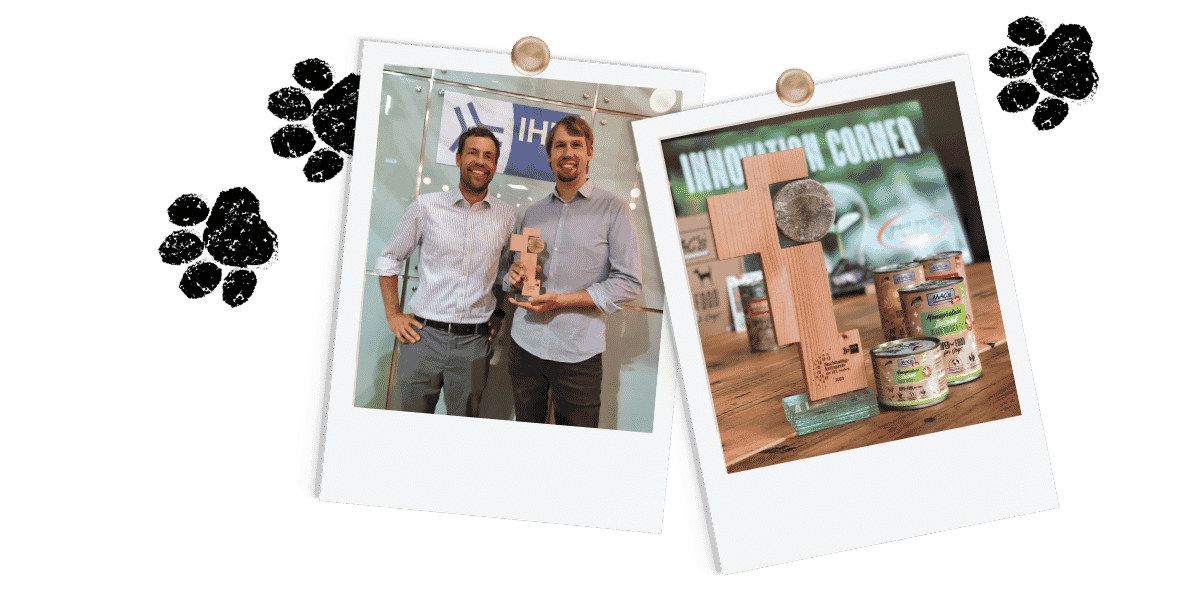
In 2023, the Aachen Chamber of Industry and Commerce (IHK) awarded its first sustainability prize to companies from the region, recognizing their vegetable and insect-based menus. They described the products as "pioneers of sustainable practices"—we are proud of this award and look forward to further similar innovations in the future.
¹ Yavor, KM, Lehmann, A. & Finkbeiner, M. (2020). Environmental Impacts of a Pet Dog: An LCA Case Study. Sustainability, 12(8), 3394. https://doi.org/10.3390/su12083394
² Reinhardt, G., Gärtner, S. & Wagner, T. (2020): Ecological footprints of food and dishes in Germany. Heidelberg: ifeu – Institute for Energy and Environmental Research Heidelberg.
³ Internal calculations based on the Green House Gas Protocol
⁴ Halloran, A., Roos, N., Eilenberg, J., Cerutti, AK & Bruun, S. (2016). Life cycle assessment of edible insects for food protein: A review. Agronomy for Sustainable Development, 36(4), 57. https://doi.org/10.1007/s13593-016-0392-8
⁵ Rummel, PS, Beule, L., Hemkemeyer, M., Schwalb, SA & Wichern, F. (2021). Black Soldier Fly Diet Impacts Soil Greenhouse Gas Emissions From Frass Applied as Fertilizer. Frontiers in Sustainable Food Systems, 5, 709993. https://doi.org/10.3389/fsufs.2021.709993
⁶ Halloran, A., Roos, N., Eilenberg, J., Cerutti, AK & Bruun, S. (2016). Life cycle assessment of edible insects for food protein: A review. Agronomy for Sustainable Development, 36(4), 57. https://doi.org/10.1007/s13593-016-0392-8
⁷ Galán-Díaz, JJ, Pena-Mosquera, L., Puertas-Agudo, J. & Rodríguez, J. (2024). Carbon and water footprint assessment of the production cycle of the black soldier fly (Hermetia illucens) on a farm in Spain. Environmental Development, 51, 101038. https://doi.org/10.1016/j.envdev.2024.101038
⁸ ⁹ Meyer, LF, Kölln, M. & Kamphues, J. (2019). Dog food with insects? Investigations into compound feeds with black soldier fly larvae as a protein source. Kleintierpraxis, 64(3), 124–135. https://doi.org/10.2377/0023-2076-64-124