2.5kg 110-131g
5kg 185-221g
10kg 313-371g
15kg 424-503g
20kg 526-624g
25kg 621-738g
30kg 712-846g
35kg 799-950g
40kg 884-1050g
45kg 966-1147g
50kg 1082-1241g
60kg 1198-1423g
70kg 1345-1597g
MAC's Vetcare offers selected complete feeds for dogs and cats with special health needs. The specially formulated recipes contain essential vitamins and minerals and can support a needs-based diet for various health problems.
MAC's Vetcare offers selected complete feeds for dogs and cats with special health needs. The specially formulated recipes contain essential vitamins and minerals and can support a needs-based diet for various health problems.
MAC's Vetcare offers selected complete feeds for dogs and cats with special health needs. The specially formulated recipes contain essential vitamins and minerals and can support a needs-based diet for various health problems.
MAC's Vetcare offers selected complete feeds for dogs and cats with special health needs. The specially formulated recipes contain essential vitamins and minerals and can support a needs-based diet for various health problems.
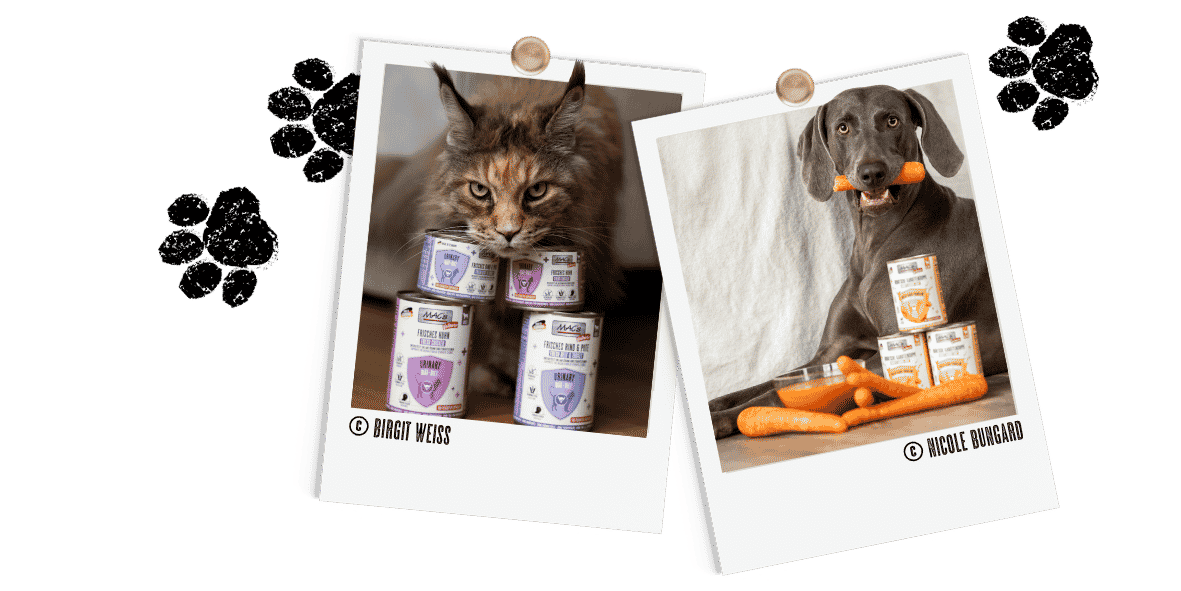
Please note that MAC's Vetcare can only provide support and is not a substitute for veterinary treatment. We recommend consulting a veterinarian before use or before extending the feeding period.

Please note that MAC's Vetcare can only provide support and is not a substitute for veterinary treatment. We recommend consulting a veterinarian before use or before extending the feeding period.

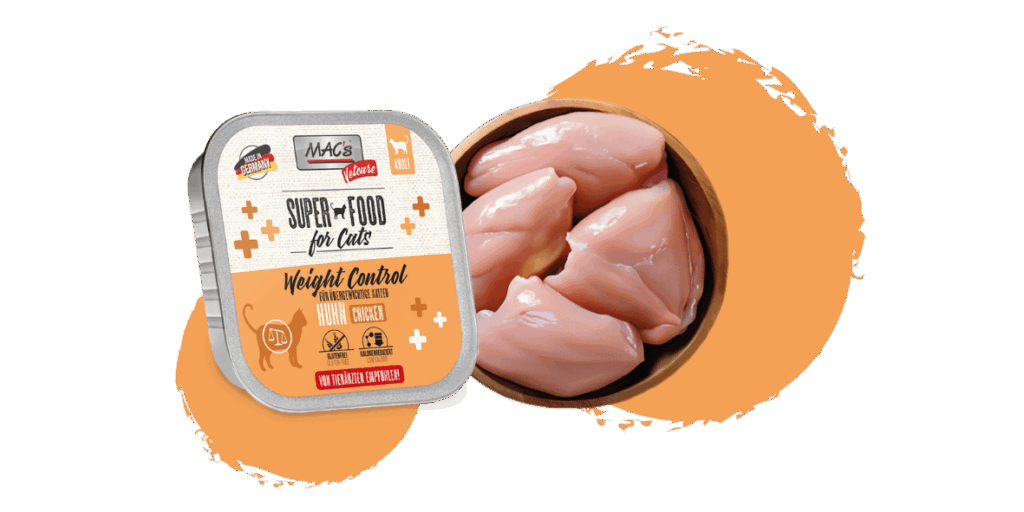
Our Weight Control Chicken variety offers a tastymaclow -fat protein source . Due to its low fat content and consequently low energy levels, this product is ideal for weight loss in overweight cats or for maintaining a healthy weight .
Recommended for: Overweight or as a preventative measure for inactive or older cats
Not suitable for: pregnant and lactating cats and kittens. Not suitable for use in cases of liver failure accompanied by impaired bile secretion.
It is recommended to seek the advice of a veterinarian before starting or extending the feeding period. All given information are guidelines.
100 g
Meat (63% chicken) and animal derivatives (chicken: heart, stomach, neck), minerals (1%).
Energy 66.1 kcal/100g
Crude protein 11.0%,
Crude fat 2.0%,
Crude ash 2.8%
, Crude fiber 0.7%
, Moisture 83%,
Calcium 0.29%,
Phosphorus 0.24%
Vitamin D3: 200 IU
Zinc (zinc sulfate, Monohydrate): 25mg/kg
Manganese (manganese II sulfate, Monohydrate): 1.4mg/kg
Copper (copper II sulfate, pentahydrate): 1.0mg/kg
Iodine (calcium iodate anhydrous): 0.75mg/kg
Taurine: 1500mg/kg
2-3kg – 124-234g
4kg – 197-284g
5kg – 229-330g
6kg – 259-373g
7kg – 287-413g
8-9kg – 313-489g
These figures are guidelines only. Your pet's actual nutritional needs vary and may differ depending on age, sex, breed, or activity level.
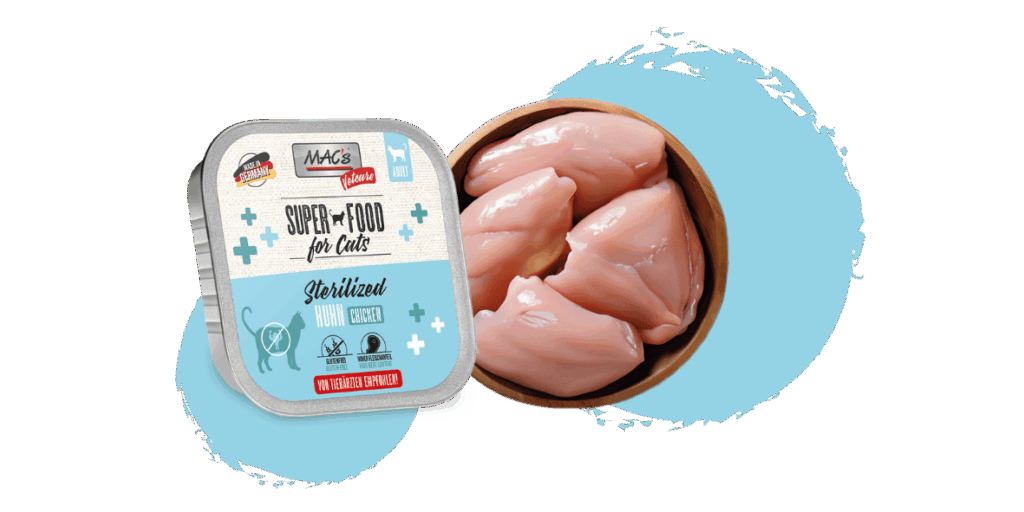
Sterilized Chicken is specially formulated to meet the needs of sterilized cats . This variety contains only low-fat protein sources. Since sterilized cats are more prone to weight gain, the product's low fat and energy content makes it ideal for weight loss or maintenance .
Recommended for: neutered cats for weight loss and maintenance
Not suitable for: pregnant and nursing cats and kittens.
It is recommended to seek the advice of a veterinarian before starting or extending the feeding period. All given information are guidelines.
100 g
Meat (68% chicken) and animal derivatives (chicken: heart, stomach, liver), cranberrys (2%), minerals (1%), salmon oil (0,2%).
Energy content 71kcal/100g
Crude protein 10.2%,
Crude fat 5.0%,
Crude ash 2.0%,
Crude fiber 0.5%
, Moisture 80%,
Calcium 0.27%,
Phosphorus 0.25%
Vitamin D3: 200 IU
Zinc (zinc sulfate, Monohydrate): 25mg/kg
Manganese (manganese (II) sulfate, Monohydrate): 1.4mg/kg
Copper (copper II sulfate, pentahydrate): 1.0mg/kg
Iodine (calcium iodate, anhydrous): 0.75mg/kg
Taurine: 1500mg/kg
DL-methionine: 500mg
2-3kg – 86-163g
4kg – 137-198g
5kg – 159-230g
6kg – 180-260g
7kg – 200-288g
8-9kg – 218-341g
These figures are guidelines only. Your pet's actual nutritional needs vary and may differ depending on age, sex, breed, or activity level.
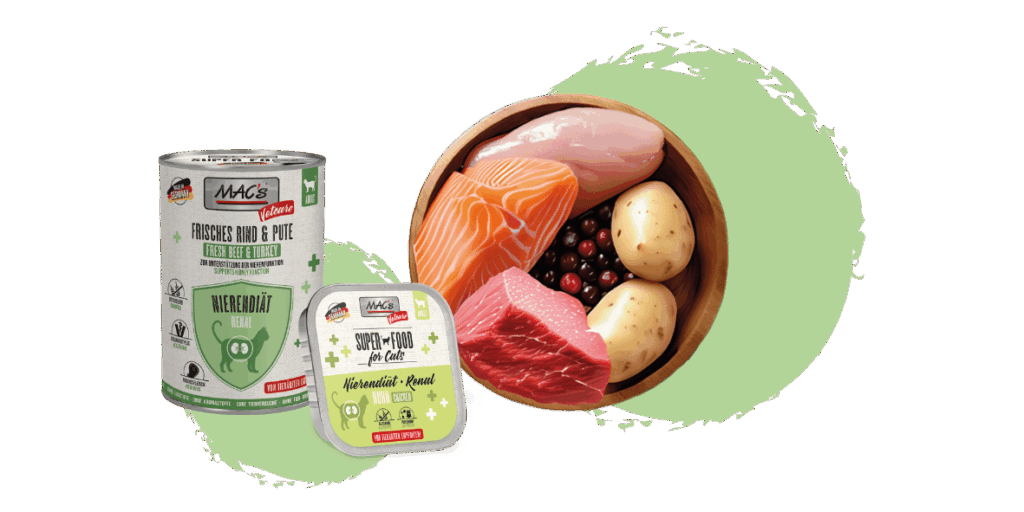
Cat Vetcare Renal Diet is specially formulated for cats suffering from chronic or acute kidney failure . By combining high-quality protein sources with a grain-free recipe, the range provides your cat with essential amino acids. The reduced protein content helps decrease the formation and accumulation of harmful waste products, thus relieving the strain on weakened kidneys. The adjusted phosphorus and sodium levels provide additional support for the kidneys. Available
the various varieties offer even the pickiest eatersmacmeal.
Vomiting
Loss of appetite or complete refusal to eat
Little to no urination, or conversely, more frequent urination
Dehydration (e.g., dry mucous membranes, skin tenting)
Lethargy, weakness, or withdrawal
Foul-smelling breath (often with an ammonia-like odor)
Signs of abdominal pain (e.g., hunched posture, defensive behavior when touched)
Recommended for: chronic or temporary renal insufficiency
Not suitable for: pregnant and nursing cats and kittens
It is recommended to seek the advice of a veterinarian before starting or extending the feeding period. All given information are guidelines.
Vomiting
Loss of appetite or complete refusal to eat
Little to no urination, or conversely, more frequent urination
Dehydration (e.g., dry mucous membranes, skin tenting)
Lethargy, weakness, or withdrawal
Foul-smelling breath (often with an ammonia-like odor)
Signs of abdominal pain (e.g., hunched posture, defensive behavior when touched)
Recommended for: chronic or temporary renal insufficiency
Not suitable for: pregnant and nursing cats and kittens
It is recommended to seek the advice of a veterinarian before starting or extending the feeding period. All given information are guidelines.
200 g & 400 g
48% Beef (consisting of beef, beef lung, beef heart, beef fat, beef broth), 32.5% Turkey (consisting of turkey meat, turkey heart, turkey liver, turkey gizzard, turkey broth), 16% Potato, 1% Minerals, 0.7% Cranberry*, 0.5% Apple Pomace*, 0.4% Linseed Oil (pressed), 0.2% Dandelion Leaves, 0.15% Algae. (*dried)
Crude protein 7.5%,
Crude fat 10.2%,
Crude fiber 0.4%,
Crude ash 2.2%,
Moisture 75.0%,
Phosphorus 0.21%,
Calcium 0.28%,
Sodium 0.20%,
Magnesium 0.02%,
Potassium 0.27%
Vitamin D3: 200 iU
Vitamin E: 20 iU
Zinc (zinc sulfate,Monohydrate: 25 mg
manganese (manganese (II) sulfate, Monohydrate: 1.4 mg
iodine (calcium iodate, anhydrous: 0.75 mg
Taurine: 1,200 mg
copper (copper (II) sulfate, pentahydrate: 1.0 mg
3kg 85-103g
3.5kg 93-114g
4kg 102-125g
4.5kg 110-135g
5kg 119-145g
6kg 134-164g
7kg 149-182g
8kg 162-199g
3kg 133-162g
3.5kg 148-179g
4kg 162-196g
4.5kg 175-213g
5kg 187-228g
6kg 211-258g
7kg 234-286g
8kg 256-313g
These figures are guidelines only. Your pet's actual nutritional needs vary and may differ depending on age, sex, breed, or activity level.
200 g & 400 g
82.6% Chicken (consisting of chicken meat, chicken heart, chicken gizzard, chicken liver, chicken skin, chicken broth), 15% Potato, 1% Minerals, 0.7% Cranberry*, 0.5% Apple Pomace*, 0.2% Linseed Oil (pressed), 0.15% Algae. (*dried)
Crude protein 7.6%,
Crude fat 8.6%,
Crude fiber 0.4%,
Crude ash 1.4%,
Moisture 78.5%,
Phosphorus 0.12%,
Calcium 0.15%,
Sodium 0.17%,
Magnesium 0.01%,
Potassium 0.25%
Vitamin: 200 iU
Vitamin E: 20 iU
Zinc (zinc sulfate, Monohydrate): 25 mg
Manganese (manganese (II) sulfate, Monohydrate: 1.4 mg
Iodine (calcium iodate, anhydrous): 0.75 mg
Taurine: 1,200 mg
Copper (copper (II) sulfate, pentahydrate): 1.0 mg
3kg 98-119g
3.5kg 108-132g
4kg 118-144g
4.5kg 127-156g
5kg 137-168g
6kg 155-189g
7kg 172-210g
8kg 187-229g
3kg 153-187g
3.5kg 170-270g
4kg 186-227g
4.5kg 202-286g
5kg 252-246g
6kg 244-298g
7kg 271-330g
8kg 296-361g
These figures are guidelines only. Your pet's actual nutritional needs vary and may differ depending on age, sex, breed, or activity level.
100 g
Meat (33% beef, 17% chicken) and animal derivatives (beef heart, beef lung, chicken heart), potato (14%), minerals (1%).
Crude protein 8.1%,
Crude fat 7.3%,
Crude ash 2.5%,
Crude fiber 0.6%,
Moisture 78%,
Calcium 0.17%,
Phosphorus 0.14%,
Sodium 0.17%,
Potassium 0.33%
Vitamin D3: 200 IU
Zinc (zinc sulfate, Monohydrate): 25mg/kg
Manganese (manganese (II) sulfate, Monohydrate): 1.4mg/kg
Copper (copper II sulfate, pentahydrate): 1.0mg/kg
Iodine (calcium iodate anhydrous): 0.75mg/kg
Taurine: 1500mg/kg
2-3kg – 75-142g
4kg – 120-172g
5kg – 139-200g
6kg – 157-226g
7kg – 174-251g
8-9kg – 190-297g
These figures are guidelines only. Your pet's actual nutritional needs vary and may differ depending on age, sex, breed, or activity level.
100 g
Meat (50% chicken) and animal derivatives (chicken: heart, stomach, fat), potato (12%), minerals (1%).
Crude protein 7.9%,
Crude fat 7.6%,
Crude ash 2.4%,
Crude fiber 0.5%,
Moisture 78.5%,
Calcium 0.16%,
Phosphorus 0.13%,
Sodium 0.16%,
Potassium 0.33%
Vitamin D3: 200 IU
Zinc (zinc sulfate, Monohydrate): 25mg/kg
Manganese (manganese (II) sulfate, Monohydrate): 1.4mg/kg
Copper (copper II sulfate, pentahydrate): 1mg/kg
Iodine (calcium iodate anhydrous): 0.75mg/kg
Taurine: 1500mg/kg
2-3kg – 74-141g
4kg – 118-170g
5kg – 137-198g
6kg – 155-224g
7kg – 172-248g
8-9kg – 188-293g
These figures are guidelines only. Your pet's actual nutritional needs vary and may differ depending on age, sex, breed, or activity level.
100 g
Meat (50% chicken) and animal derivatives (chicken: heart, stomach, fat), potato (12%), salmon (6%), minerals (1%).
Crude protein 7.8%,
Crude fat 8.4%,
Crude ash 2.5%,
Crude fiber 0.5%,
Moisture 77.5%,
Calcium 0.21%,
Phosphorus 0.14%,
Sodium 0.15%,
Potassium 0.3%
Zinc (zinc sulfate, Monohydrate): 25mg/kg
Manganese (manganese (II) sulfate, Monohydrate): 1.4mg/kg
Copper (copper II sulfate, pentahydrate): 1.0mg/kg
Iodine (calcium iodate anhydrous): 0.75mg/kg
Taurine: 1500mg/kg
2-3kg – 79-150g
4kg – 126-181g
5kg – 146-211g
6kg – 165-238g
7kg – 183-264g
8-9kg – 200-312g
These figures are guidelines only. Your pet's actual nutritional needs vary and may differ depending on age, sex, breed, or activity level.
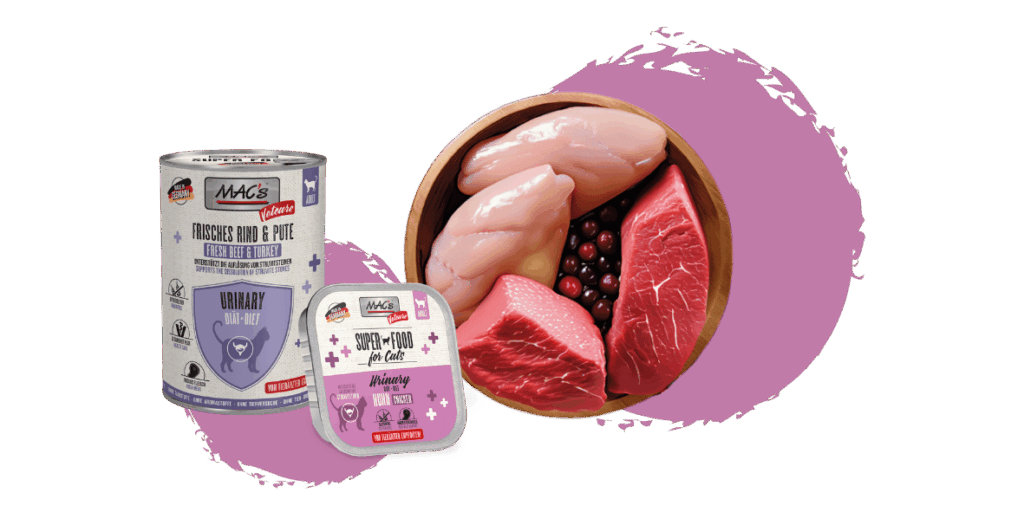
The Cat Vetcare Urinary was developed to support the dissolution of struvite stones . The reduced mineral content of this urinary diet can lower the mineral concentration in the urine. The addition of methionine can further lower the urine's pH level, making it more macto reduce the formation of struvite stones. The delicious varieties guarantee a tastymacthat can support your feline friend.
The different options in trays and cans not only offer health benefits but also guarantee an irresistible taste experience for even the pickiestmac.
Frequent urination in small amounts
Straining to urinate (often painful)
Urinating outside the litter box
Blood in urine
Loud meowing or restlessness during urination
Excessive licking of the genital area
Turbid or strongly smelling urine
In severe cases: complete urinary retention (emergency!)
Lethargy, loss of appetite, vomiting in particularly severe cases
Recommended for: adult cats with diagnosed struvite stones
Not suitable for: pregnant and nursing cats and kittens
It is recommended to seek the advice of a veterinarian before starting or extending the feeding period. All given information are guidelines.
Frequent urination in small amounts
Straining to urinate (often painful)
Urinating outside the litter box
Blood in urine
Loud meowing or restlessness during urination
Excessive licking of the genital area
Turbid or strongly smelling urine
In severe cases: complete urinary retention (emergency!)
Lethargy, loss of appetite, vomiting in particularly severe cases
Recommended for: adult cats with diagnosed struvite stones
Not suitable for: pregnant and nursing cats and kittens
It is recommended to seek the advice of a veterinarian before starting or extending the feeding period. All given information are guidelines.
200 g & 400 g
96.6% chicken (consisting of chicken meat, chicken heart, chicken gizzard, chicken liver, chicken fat, chicken meat broth), 2% cranberry, 1% minerals, 0.2% linseed oil (cold pressed), 0.2% chamomile.
Crude protein 10.2%,
Crude fat 7.2%,
Crude fiber 0.3%,
Crude ash 1.7%,
Moisture 79.0%,
Phosphorus 0.14%,
Calcium 0.14%,
Sodium 0.29%,
Magnesium 0.02%,
Potassium 0.22%,
Chloride 0.31%,
Sulfur 0.2%
Vitamin D3: 200 iU
Vitamin E: 20 iU
DL-methionine: 1000 mg
Zinc (zinc sulfate, Monohydrate): 25 mg
Manganese (manganese (II) sulfate, Monohydrate): 1.4 mg
Iodine (calcium iodate, anhydrous): 0.75 mg
Taurine: 1,200 mg
Copper (copper (II) sulfate, pentahydrate): 1.0 mg
3kg 105-128g
3.5kg 115-141g
4kg 127-155g
4.5kg 136-167g
5kg 147-180g
6kg 166-203g
7kg 184-225g
8kg 201-246g
3kg 164-201g
3.5kg 183-222g
4kg 200-243g
4.5kg 216-263g
5kg 231-282g
6kg 261-319g
7kg 290-353g
8kg 317-387g
These figures are guidelines only. Your pet's actual nutritional needs vary and may differ depending on age, sex, breed, or activity level.
200 g & 400 g
56.8% beef (consisting of beef lung, beef heart, beef liver, beef broth), 39.8% turkey (consisting of turkey meat, turkey heart, turkey gizzard, turkey meat broth), 2% apple, 1% minerals, 0.2% linseed oil (cold pressed), 0.2% nettle.
Crude protein 11.4%,
Crude fat 6.6%,
Crude fiber 0.3%,
Crude ash 1.5%,
Moisture 79.0%,
Phosphorus 0.13%,
Calcium 0.17%,
Sodium 0.28%,
Magnesium 0.01%,
Potassium 0.23%,
Chloride 0.34%,
Sulfur 0.2%
Vitamin D3 200 iU
Vitamin E: 20 iU
DL-methionine: 1000 mg
Zinc (zinc sulfate, Monohydrate): 25 mg
Manganese (manganese (II) sulfate, Monohydrate: 1.4 mg
Iodine (calcium iodate, anhydrous): 0.75 mg
Taurine: 1,200 mg
Copper (copper (II) sulfate, pentahydrate: 1.0 mg
3kg 106-130g
3.5kg 117-143g
4kg 129-157g
4.5kg 139-170g
5kg 149-182g
6kg 169-206g
7kg 187-228g
8kg 204-250g
3kg 167-204g
3.5kg 185-225g
4kg 203-247g
4.5kg 220-267g
5kg 235-287g
6kg 265-324g
7kg 295-359g
8kg 322-393g
These figures are guidelines only. Your pet's actual nutritional needs vary and may differ depending on age, sex, breed, or activity level.
100 g
Meat (69% chicken) and animal derivatives (chicken: heart, stomach, liver, fat), minerals (1%).
Crude protein 11.5%,
Crude fat 4.0%,
Crude ash 1.9%,
Crude fiber 0.3%,
Moisture 81%,
Calcium 0.17%,
Phosphorus 0.13%,
Sodium 0.12%,
Chloride 0.21%,
Magnesium 0.02%,
Potassium 0.29%,
Sulfur 0.19%
Vitamin D3: 200 IU
Zinc (zinc sulfate, Monohydrate): 25mg/kg
Manganese (manganese (II) sulfate, Monohydrate): 1.4mg/kg
Copper (copper II sulfate, pentahydrate): 1.0mg/kg
Iodine (calcium iodate anhydrous): 0.75mg/kg
Taurine: 1500mg/kg
DL-methionine: 3,000 mg
2-3kg – 86-163g
4kg – 137-198g
5kg – 159-230g
6kg – 180-260g
7kg – 200-288g
8-9kg – 218-341g
These figures are guidelines only. Your pet's actual nutritional needs vary and may differ depending on age, sex, breed, or activity level.
100 g
Meat (min. 39% chicken, 30% turkey) and animal derivatives (chicken: heart, stomach, liver, turkey: heart, stomach, liver) minerals (1%), salmon oil (0,2%).
Crude protein 11.5%,
Crude fat 4.6%,
Crude ash 1.9%,
Crude fiber 0.3%,
Moisture 80%,
Calcium 0.17%,
Phosphorus 0.14%,
Sodium 0.12%,
Chloride 0.21%,
Magnesium 0.02%,
Potassium 0.29%,
Sulfur 0.19%
Vitamin D3: 200 IU
Zinc (zinc sulfate, Monohydrate): 25mg/kg
Manganese (manganese (II) sulfate, Monohydrate): 1.4mg/kg
Copper (copper II sulfate, pentahydrate): 1.0mg/kg
Iodine (calcium iodate anhydrous): 0.75mg/kg
Taurine: 1500mg/kg
DL-methionine: 2,000mg/kg
2-3kg 86-163g
4kg 137-198g
5kg 159-230g
6kg 180-260g
7kg 200-288g
8-9kg 218-341g
These figures are guidelines only. Your pet's actual nutritional needs vary and may differ depending on age, sex, breed, or activity level.
100 g
Meat (min. 35% turkey, 34% beef) and animal derivatives (turkey: heart, stomach, liver, beef: heart, liver, lung), minerals (1%), salmon oil (0,3%).
Crude protein 11.5%,
Crude fat 5.7%,
Crude ash 2.0%,
Crude fiber 0.4
%, Moisture 78.5%,
Calcium 0.18%,
Phosphorus 0.15%,
Sodium 0.15%,
Chloride 0.25%,
Magnesium 0.02%,
Potassium 0.29%,
Sulfur 0.21%
Vitamin D3: 200 IU
Zinc (zinc sulfate, Monohydrate): 25mg/kg
Manganese (manganese (II) sulfate, Monohydrate): 1.4mg/kg
Copper (copper II sulfate, pentahydrate): 1.0mg/kg
Iodine (calcium iodate anhydrous): 0.75mg/kg
Taurine: 1500mg/kg
DL-methionine: 2,000mg/kg
2-3kg 86-163g
4kg 137-198g
5kg 159-230g
6kg 180-260g
7kg 200-288g
8-9kg 218-341g
These figures are guidelines only. Your pet's actual nutritional needs vary and may differ depending on age, sex, breed, or activity level.
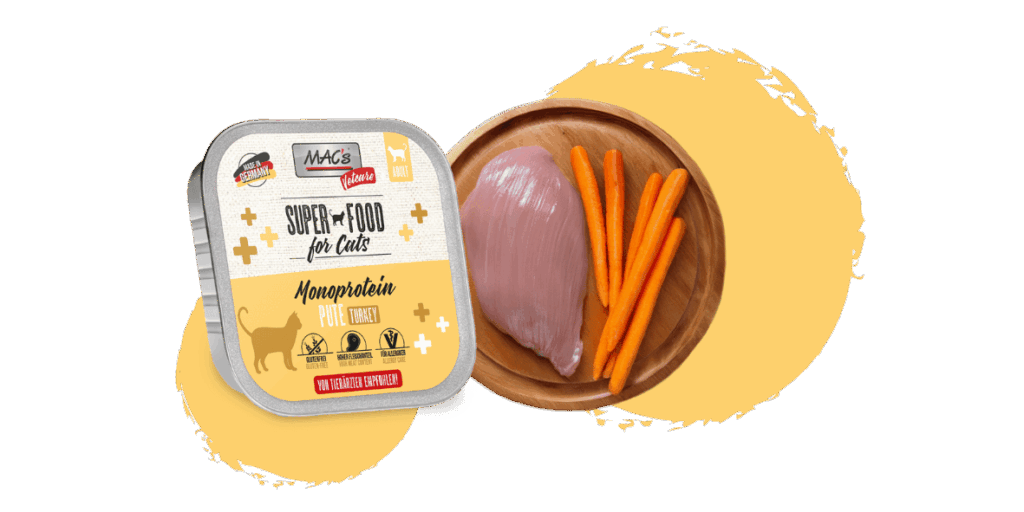
Monoprotein turkey consists of only one type of meat as its protein source. Mono is ideal for sensitive cats. This grain-free complete food has been developed to enhance your pet's well-being. Gentle preparation and the addition of vitamins and minerals guarantee a natural diet.
100 g
Meat (min. 70% turkey) and animal derivatives (turkey heart, turkey gizzard, turkey liver), carrots (2%), minerals (1%), safflower oil (0,2%).
Crude protein 10.8%,
Crude fat 5.2%,
Crude ash 2.3%
, Crude fiber 0.4%,
Moisture 80%,
Calcium 0.18%
Vitamin D3: 200 IU
Zinc (zinc sulfate, Monohydrate): 25mg/kg
Manganese (manganese (II) sulfate, Monohydrate): 1.4mg/kg
Copper (copper II sulfate, pentahydrate): 0.5mg/kg
Iodine (calcium iodate anhydrous): 0.75mg/kg
Taurine: 1500mg/kg
2-3kg – 108-173g
4kg – 131-204g
5kg – 152-219g
6kg – 172-248g
7kg – 190-275g
8-9kg – 208-300g
These figures are guidelines only. Your pet's actual nutritional needs vary and may differ depending on age, sex, breed, or activity level.
Just like humans, dogs can become overweight for a variety of reasons. Excess weight can have serious consequences for our four-legged friend's health and quality of life.
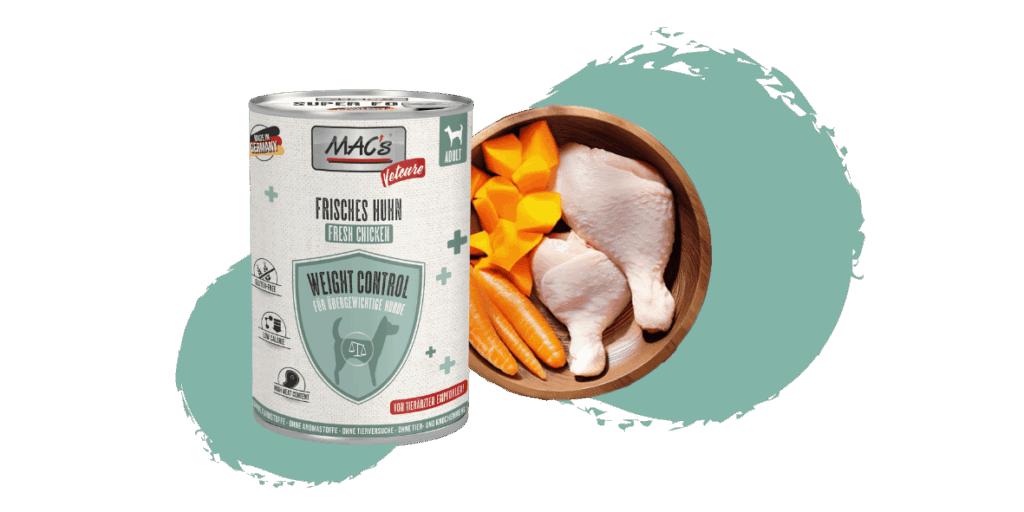
Dog Vetcare Weight Control can support your dog's weight loss. The cellulose can help regulate digestion and provide a long-lasting feeling of fullness .
This variety is low in calories while maintaining the same nutritional quality , and the detailed feeding instructions ensure controlled calorie intake. Fresh chicken and whole egg powder, as high-quality protein sources, help maintain muscle mass, and specific vitamins and minerals support overall health. A moderate fat content also meets your dog's energy needs.
The effects of obesity on a dog can have consequences and significantly impair its quality of life. These include:
Recommended for: adult and overweight dogs
Not suitable for: pregnant and lactating bitches and puppies
It is recommended to seek the advice of a veterinarian before starting or extending the feeding period. All given information are guidelines.
200 g & 400 g
Crude protein 8.0%,
crude fat 2.9%,
crude fiber 1.1%,
crude ash 1.9%,
moisture 81.8%
Vitamin D3: 200 iU
Vitamin E: 20 iU
Zinc (zinc sulfate, Monohydrate) 25 mg
Manganese (manganese (II) sulfate, Monohydrate) 1.4 mg
Iodine (calcium iodate, anhydrous) 0.75 mg
Copper (copper (II) sulfar, pentahydrate) 1.0 mg
2.5kg – 171-198g
5kg – 288-333g
10kg – 483-560g
15kg – 656-759g
813-942g
25kg – 962-1114g
30kg – 1103-1277g
35kg – 1238-1433g
40kg – 1368-1584g
45kg – 1495-1730g
50kg – 1617-1872g
60kg – 1854-2147g
70kg – 2082-2410g
2.5kg – 252-313g
5kg – 424-526g
10kg – 712-884g
15kg – 965-1197g
20kg – 1197-1486g
25kg – 1416-1757g
30kg – 1624-2014g
35kg – 1823-2261g
40kg – 2015-2500g
45kg – 2201-2730g
50kg – 2381-2954g
60kg – 2731-3387g
70kg – 3065-3803g
Until the target weight is reached and as needed to maintain the normal weight.
To achieve efficient weight loss or to maintain an ideal weight, the recommended daily energy intake should not be exceeded.
These figures are guidelines only. Your pet's actual nutritional needs vary and may differ depending on age, sex, breed, or activity level.
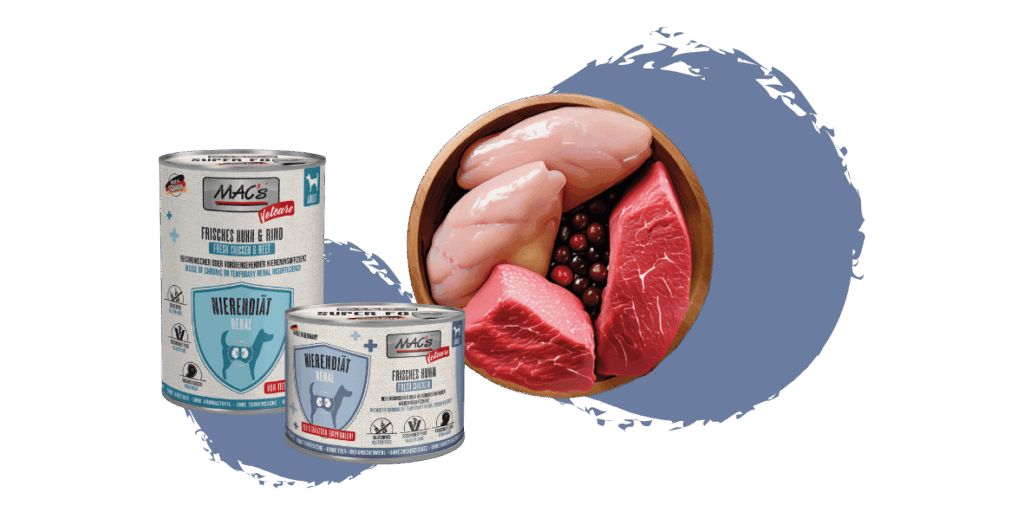
In cases of chronic or acute kidney failure, the kidneys lose their ability to filter waste products from the blood and regulate the body's fluid balance.
Dog Vetcare renal diets are low in protein and phosphorus, as high protein intake can put additional strain on the kidneys. Controlled phosphorus levels are important because diseased kidneys lose their ability to excrete phosphate.
Furthermore, omega-3 fatty acids from salmon oil and microalgae can help reduce inflammation. A lower sodium content can prevent fluid retention, and antioxidants can help combat free radicals and protect cells.
Vomiting
Diarrhea
Loss of appetite
Reduced urination or inability to urinate
Dehydration
Lethargy or weakness
Bad breath
Signs of abdominal pain
Recommended for: chronic or temporary renal insufficiency
Not suitable for: pregnant and lactating bitches and puppies
It is recommended to seek the advice of a veterinarian before starting or extending the feeding period. All given information are guidelines.
Vomiting
Diarrhea
Loss of appetite
Reduced urination or inability to urinate
Dehydration
Lethargy or weakness
Bad breath
Signs of abdominal pain
Recommended for: chronic or temporary renal insufficiency
Not suitable for: pregnant and lactating bitches and puppies
It is recommended to seek the advice of a veterinarian before starting or extending the feeding period. All given information are guidelines.
200 g & 400 g
47.5% chicken (consisting of chicken meat, chicken heart, chicken fat, chicken gizzard, chicken meat broth), 27.2% beef (consisting of beef, beef liver, beef lung, beef heart, beef broth), 20% potato, 3% rice, 1% minerals, 0.7% cranberry*, 0.5% apple pomace*, 0.2% linseed oil (cold-pressed), 0.2% nettle leaves, 0.15% algae, 0.1% salmon oil (refined). (*dried)
Crude protein 6.7%,
Crude fat 10.8%,
Crude fiber 0.7%,
Crude ash 1.5%,
Moisture 73.0%,
Phosphorus: 0.11%,
Calcium: 0.15%,
Sodium: 0.15%,
Magnesium: 0.01%
, Potassium: 0.27%
Vitamin D3: 200 iU
Vitamin A: 2,000 iU
Vitamin E: 20 iU
Zinc (zinc sulfate, Monohydrate): 25 mg
Manganese (manganese (II) sulfate, Monohydrate): 1.4 mg
Iodine (calcium iodate, anhydrous: 0.75 mg
Copper (copper (II) sulfate, pentahydrate): 1.0 mg
2.5kg 131-152g
5kg 221-256g
10kg 371-430g
15kg 503-582g
20kg
624-722g 25kg 738-854g
30kg 846-979g
35kg 950-1100g
40kg 1050-1216g
45kg 1147-1327g
50kg 1241-1436g
60kg 1423-1647g
70kg 1597-1849g
2.5kg 110-131g
5kg 185-221g
10kg 313-371g
15kg 424-503g
20kg 526-624g
25kg 621-738g
30kg 712-846g
35kg 799-950g
40kg 884-1050g
45kg 966-1147g
50kg 1082-1241g
60kg 1198-1423g
70kg 1345-1597g
These figures are guidelines only. Your pet's actual nutritional needs vary and may differ depending on age, sex, breed, or activity level.
200 g & 400 g
47.5% chicken (consisting of chicken meat, chicken heart, chicken fat, chicken gizzard, chicken meat broth), 27.2% beef (consisting of beef, beef liver, beef lung, beef heart, beef broth), 20% potato, 3% rice, 1% minerals, 0.7% cranberry*, 0.5% apple pomace*, 0.2% linseed oil (cold-pressed), 0.2% nettle leaves, 0.15% algae, 0.1% salmon oil (refined). (*dried)
Crude protein 6.7%,
Crude fat 10.8%,
Crude fiber 0.7%,
Crude ash 1.5%,
Moisture 73.0%,
Phosphorus: 0.11%,
Calcium: 0.15%,
Sodium: 0.15%,
Magnesium: 0.01%
, Potassium: 0.27%
Vitamin D3: 200 iU
Vitamin A: 2,000 iU
Vitamin E: 20 iU
Zinc (zinc sulfate, Monohydrate): 25 mg
Manganese (manganese (II) sulfate, Monohydrate): 1.4 mg
Iodine (calcium iodate, anhydrous: 0.75 mg
Copper (copper (II) sulfate, pentahydrate): 1.0 mg
2.5kg 131-152g
5kg 221-256g
10kg 371-430g
15kg 503-582g
20kg
624-722g 25kg 738-854g
30kg 846-979g
35kg 950-1100g
40kg 1050-1216g
45kg 1147-1327g
50kg 1241-1436g
60kg 1423-1647g
70kg 1597-1849g
2.5kg 110-131g
5kg 185-221g
10kg 313-371g
15kg 424-503g
20kg 526-624g
25kg 621-738g
30kg 712-846g
35kg 799-950g
40kg 884-1050g
45kg 966-1147g
50kg 1082-1241g
60kg 1198-1423g
70kg 1345-1597g
These figures are guidelines only. Your pet's actual nutritional needs vary and may differ depending on age, sex, breed, or activity level.
200 g & 400 g
75.1% chicken (consisting of chicken meat, chicken heart, chicken fat, chicken liver, chicken gizzard, chicken meat broth), 15% potato, 5% carrot, 3% rice, 1% minerals, 0.7% cranberry*, 0.5% apple pomace*, 0.2% dandelion leaves, 0.15% algae. (*dried)
Crude protein 6.8%,
Crude fat 10.6%,
Crude fiber 0.8%,
Crude ash 1.5%,
Moisture 72.5%,
Phosphorus 0.1%,
Calcium 0.13%,
Sodium 0.15%,
Magnesium 0.01%,
Potassium 0.26%
Vitamin D3: 200 IU
Vitamin A: 2,000 IU
Vitamin E: 20 IU
Zinc (zinc sulfate, Monohydrate): 25 mg
Manganese (manganese (II) sulfate, Monohydrate): 1.4 mg
Iodine (calcium iodate, anhydrous): 0.75 mg
Copper (copper (II) sulfate, pentahydrate): 1.0 mg
2.5kg 131-152g
5kg 221-255g
10kg 371-430g
15kg 503-582g
20kg
624-722g 25kg 738-854g
30kg 846-979g
35kg 949-1099g
40kg 1049-1215g
45kg 1146-1326g
50kg 1240-1435g
60kg 1421-1646g
70kg 1596-1848g
2.5kg 110-131g
5kg 185-221g
10kg 312-371g
15kg 423-502g
20kg 525-623g
25kg 620-737g
30kg 711-845g
35kg 799-949g
40kg 883-1049g
45kg 965-1146g
50kg 1081-1240
60kg 1197-1421g
70kg 1344-1596g
These figures are guidelines only. Your pet's actual nutritional needs vary and may differ depending on age, sex, breed, or activity level.
200 g & 400 g
75.1% chicken (consisting of chicken meat, chicken heart, chicken fat, chicken liver, chicken gizzard, chicken meat broth), 15% potato, 5% carrot, 3% rice, 1% minerals, 0.7% cranberry*, 0.5% apple pomace*, 0.2% dandelion leaves, 0.15% algae. (*dried)
Crude protein 6.8%,
Crude fat 10.6%,
Crude fiber 0.8%,
Crude ash 1.5%,
Moisture 72.5%,
Phosphorus 0.1%,
Calcium 0.13%,
Sodium 0.15%,
Magnesium 0.01%,
Potassium 0.26%
Vitamin D3: 200 IU
Vitamin A: 2,000 IU
Vitamin E: 20 IU
Zinc (zinc sulfate, Monohydrate): 25 mg
Manganese (manganese (II) sulfate, Monohydrate): 1.4 mg
Iodine (calcium iodate, anhydrous): 0.75 mg
Copper (copper (II) sulfate, pentahydrate): 1.0 mg
2.5kg 131-152g
5kg 221-255g
10kg 371-430g
15kg 503-582g
20kg
624-722g 25kg 738-854g
30kg 846-979g
35kg 949-1099g
40kg 1049-1215g
45kg 1146-1326g
50kg 1240-1435g
60kg 1421-1646g
70kg 1596-1848g
2.5kg 110-131g
5kg 185-221g
10kg 312-371g
15kg 423-502g
20kg 525-623g
25kg 620-737g
30kg 711-845g
35kg 799-949g
40kg 883-1049g
45kg 965-1146g
50kg 1081-1240
60kg 1197-1421g
70kg 1344-1596g
These figures are guidelines only. Your pet's actual nutritional needs vary and may differ depending on age, sex, breed, or activity level.
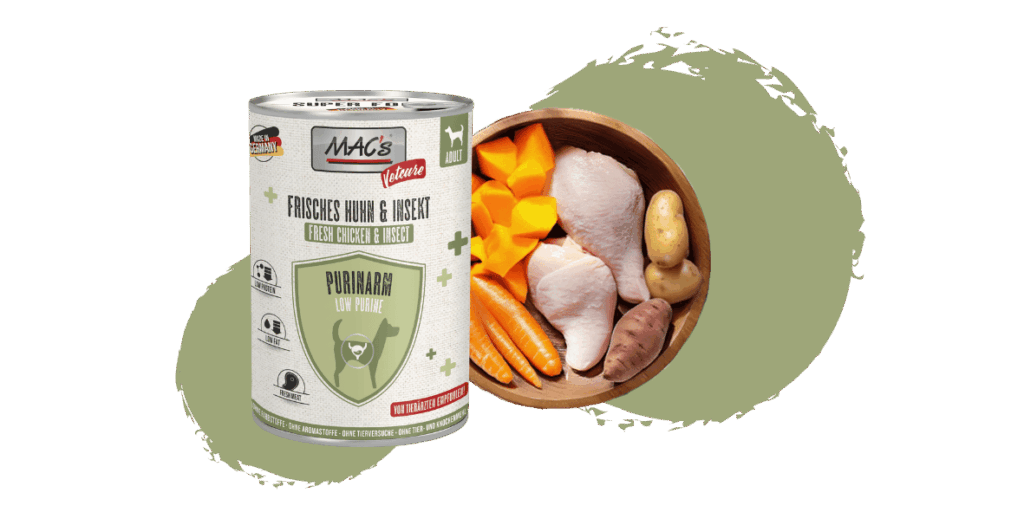
Purines are components of proteins that are broken down into uric acid during metabolism. If a dog’s body is unable to properly process or excrete excess purines, high purine levels can accumulate in the blood. This may lead to various health issues, including the formation of urinary stones, gout, arthritis, as well as heart or metabolic problems.
Dog Vetcare Purinarm can support digestion and muscle development with its low purine content . The lean, fresh chicken and black soldier fly larvae are low in purines and protein . Furthermore, excessive fillers and additives are avoided to keep the purine content low and provide high-quality nutrition.
Genetic predisposition: Some dogs may have a genetically determined increased tendency to accumulate purines.
Malnutrition: A diet rich in purine-rich foods such as organ meats, certain types of meat, and legumes can lead to an increase in purine levels.
Diseases: Certain diseases such as kidney failure, liver disease or diabetes can impair purine metabolism and lead to elevated purine levels.
Medications: Some medications can affect purine metabolism and lead to an increase in purine levels.
Recommended for: Dogs with elevated purine levels, as well as those requiring a liver- and kidney-friendly diet and reduced phosphorus and protein content.
Not suitable for: pregnant and lactating bitches and puppies
It is recommended to seek the advice of a veterinarian before starting or extending the feeding period. All given information are guidelines.
200 g & 400 g
53.2% Chicken (consisting of chicken meat, chicken broth), 10% Insect (consisting of insect larvae (Black Soldier Fly)), 10% Sweet potato, 10% Pumpkin, 10% Potato, 5% Rice flour, 0.7% Whole egg powder, 0.5% Minerals, 0.4% Sunflower oil (refined), 0.2% Nettle.
Crude protein 6.0%
Crude fat 4.5%
Crude fiber 0.5%
Crude ash 1.8
% Moisture 80.0%
Vitamin A 2,000 iU
Vitamin D3 200 IU
Zinc (zinc sulfate, Mono) 25 mg
Iodine (calcium iodate, anhydrous) 0.75 mg
Copper (copper (II) sulfate, pentahydrate) 1.0 mg
Selenium (sodium selenite) 0.05 mg
2.5kg – 214-248g
5kg – 359-416g
10kg – 604-700g
15kg – 818-947g
20kg – 1015-1176g
25kg – 1201-1391g
30kg – 1377-1594g
35kg – 1545-1790g
40kg – 1708-1978g
45kg – 1866-2160g
50kg – 2019-2338g
60kg – 2315-2680g
70kg – 2599-3009g
2.5kg – 180-214g
5kg – 302-359g
10kg – 509-604g
15kg – 690-818g
20kg – 856-1015g
25kg – 1011-1201g
30kg – 1159-1377g
35kg – 1301-1545g
40kg – 1438-1708g
45kg – 1571-1866g
50kg – 1761-2019g
60kg – 1950-2315g
70kg – 2189-2599g
These figures are guidelines only. Your pet's actual nutritional needs vary and may differ depending on age, sex, breed, or activity level.
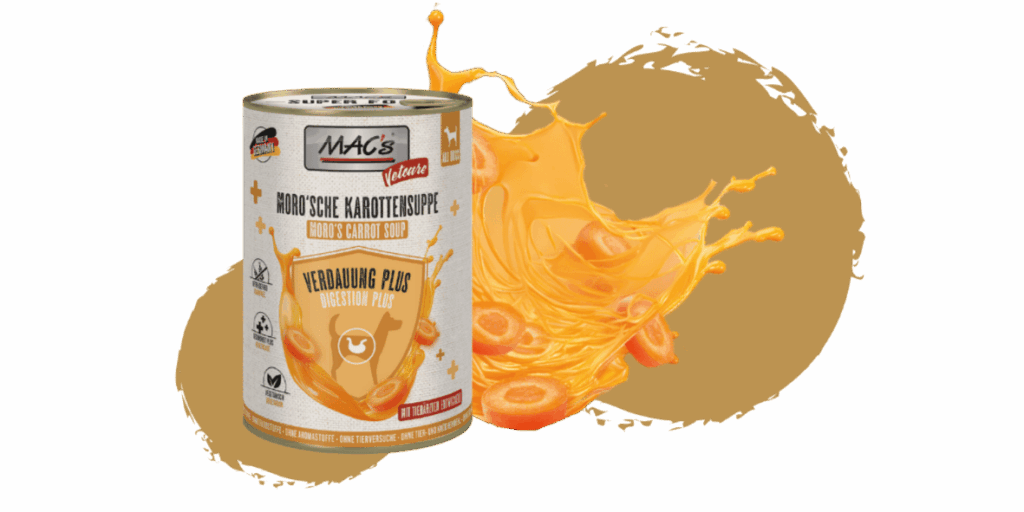
Moro's Carrot Soup is an old family recipe prized for its unique composition and nutritional support for bowel function . The carrots are cooked for a very long time, providing specific types of fiber that aid digestion. MAC's Moro's Carrot Soup recipe has been further developed with psyllium husks. These are rich in soluble fiber and are characterized by their exceptional swelling capacity. In the digestive tract, they absorb water and increase in volume. Due to their water-binding properties, psyllium husks can also contribute to balanced stool consistency. The soup also has a high moisture content and contains of natural sea salt – a combination that harmoniously rounds out the recipe.
Food intolerances or allergies: If a dog eats something that triggers intolerances or allergies, gastrointestinal problems or diarrhea may occur.
Changing your dog: Sudden changes in diet can irritate a dog's gastrointestinal tract and lead to diarrhea or other gastrointestinal problems. Therefore, it is important to change the food gradually.
Bacterial or viral infections: Infections such as parvovirus, canine coronavirus or salmonella can also cause diarrhea in dogs.
Parasite infestation: Worms such as roundworms, hookworms or Giardia can be responsible for diarrhea.
Stress: Stress or anxiety can affect a dog's gastrointestinal tract and cause diarrhea. This can be triggered by changes in the environment, separation anxiety, or other stressors.
Medications: Some medications can cause gastrointestinal problems and diarrhea as a side effect.
Toxic substances: Consuming toxic substances such as chocolate, plants, or cleaning agents can lead to diarrhea.
375 g supplementary feed
50.3% carrot, 49% water, 0.4% psyllium husk, 0.3% sea salt.
Crude protein 0.4%,
crude fat 0.1%,
crude fiber 0.4%,
crude ash 0.5%,
moisture 93.5%
5kg – 150-200g
10kg – 300-400g
20kg – 600-800g
30kg – 900-1200g
Note: Distribute approximately 30 ml per kilogram of body weight into 4-5 small portions per day.
These figures are guidelines only. Your pet's actual nutritional needs vary and may differ depending on age, sex, breed, or activity level.